
7 benefits of ABC warehouse layout
Procurement, materials, and inventory management
The location of goods in the warehouse determines whether the flow of materials within the facility is efficient. How the load is distributed throughout the warehouse, as well as on the shelving itself, affects order processing times, customer delivery times, operating costs, and efficient space management, among other factors.
Organizing a warehouse with fixed locations
There are different strategies for managing materials and inventory: fixed-location management, chaotic warehousing, and mixed management. In this article, we will focus on the first: fixed locations. When this strategy is chosen, locations are assigned to a specific product. In this way, packages are always put away and picked from the same space. As a result, each time a new unit arrives, the operator follows the same route to store the goods or retrieve them.
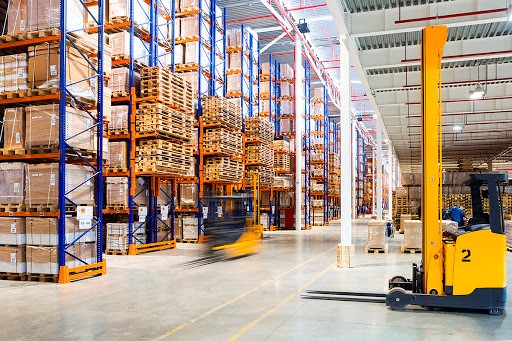
However, what happens when orders include multiple SKUs and there is no ABC layout? Operators walk hundreds of meters searching for each SKU until the order is complete. If we multiply each trip by all orders handled and by all warehouse operators, the time associated with operations skyrockets, reducing efficiency and increasing costs.
To reduce this problem, data analysis makes it possible to organize goods according to logical and efficient criteria that improve operations in terms of time and cost. Data such as sales history or each item’s attributes—such as inventory value or volumetrics—are input variables in our analysis. The result is a solution based on the Pareto principle.
The Pareto principle applied to stock management
The ABC layout is based on this Pareto principle or 80/20 rule. According to this principle, in general and across a wide range of phenomena, approximately 80% of the consequences come from 20% of the causes.
Applied to the distribution of goods in warehouses, this principle makes it possible to establish three categories:
- A items or SKUs: Around 20% of SKUs account for approximately 80% of sales.
- B items or SKUs: Around 30% of SKUs account for approximately 15% of sales.
- C items or SKUs: Around 50% of SKUs account for only 5% of sales.
This criterion can also be applied to classify SKUs based on inventory value, profit margins, returns, etc.
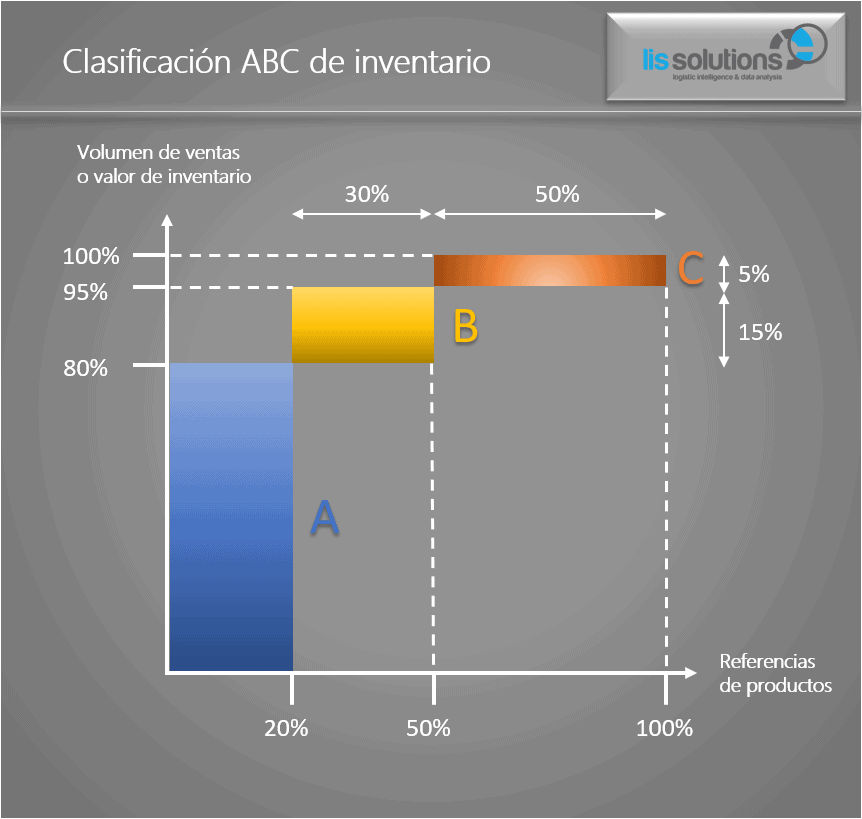
Once items have been classified using data analysis tools (Business Intelligence)[ https://www.lisdatasolutions.com/blog/que-es-business-intelligence/], the layout is implemented by placing high-turnover A items close to the outbound docks or in areas that are easy for operators to access. Next come B SKUs, and in higher or more distant areas from the outbound docks, C SKUs.
7 benefits of an ABC layout in stock management
Stock management using digitalization and decision-support tools in the supply chain makes it possible to ensure high supply levels with controlled costs.
After applying this solution across various projects and observing continuous improvement over time, we can highlight seven benefits of ABC layout:
- Reduces time and streamlines movement in operations.
- Improves space utilization: both within the locations themselves and across the facility as a whole, using the type of racking best suited to the type of A, B, or C SKU.
- Increases stock control by preventing stockouts and overstocking.
- Reduces inventory obsolescence: products considered A in one period may be B in another, or even be discontinued. New products, trends, or seasonality can cause the opposite effect.
- Cost reduction: greater efficiency in load placement, as well as in order management, will reduce costs associated with the number of resources required.
- Shorter delivery times and improved customer service levels: fewer backorders and open orders thanks to a layout based on customer demand.
- Enables combining the ABC criterion with other item characteristics such as hazardousness, expiration, temperature, volumetrics, etc., enhancing solutions through ABC-XYZ layout criteria.
Through data analysis such as sales history or inventory value, we can save time and effort in warehouse management operations.
Contact us and we will help you