
In this section
Segmentation allows customers to be divided into groups based on common characteristics. We anticipate consumer behavior by aggregating information from different sources, enabling the adaptation of marketing strategies.
Objectives
- Aggregate information from different sources
- Classify customers into different groups
- Generate data for targeted marketing campaigns
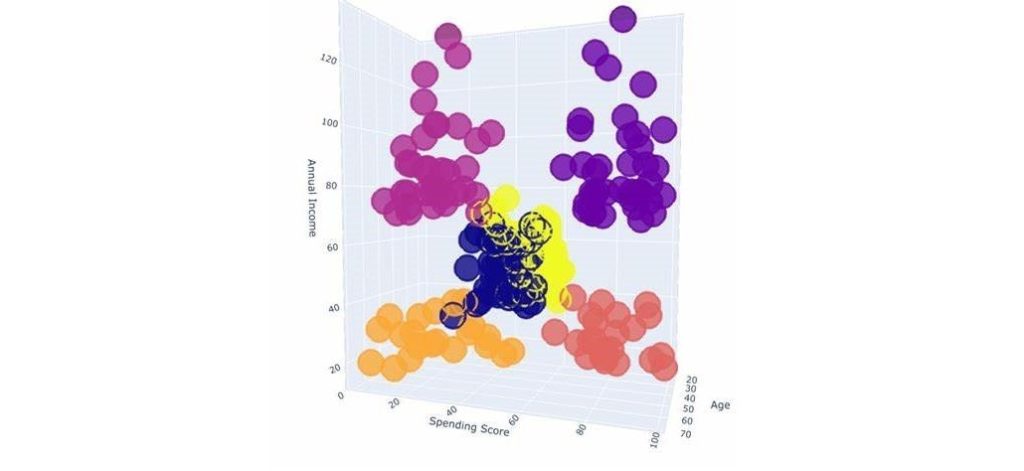
To generate marketing campaigns tailored to customer groups with specific objectives, it is necessary to start with customer segmentation based on information captured from various sources, such as loyalty programs.
What we do
Based on information collected over time from different systems, we aggregate and model this data to subsequently perform clustering processes, from which we obtain a classification of customers and common patterns among them.
How we do it
Aggregation and Transformation of Source Data
We select the data sources, connections, and transformations necessary to obtain a unified dataset.
We select the variables with which the model will perform customer correlations and segmentation.
Clustering
Using time series and specific information, we perform in-depth analysis, identifying relationships between homogeneous groups based on behaviors and habits, utilizing K-NN, K-Means, or PCA algorithms.
Selection of Indicators and Dashboards
We calculate specific KPIs.
We develop the visualization of results in BI tools, creating a user-friendly environment for analysis and decision-making in a data-driven context.