
In this section
An Artificial Intelligence-powered model is generated that considers all variables affecting both slotting and reslotting, providing the user with a continuous improvement and optimization proposal, autonomously and automatically.
Objectives
- Automate and optimize the slotting and reslotting improvement process
- Improve material flows, productivity, and service quality.
- Reduce distances and times in work order operations.
Within warehouse operations, there is a process of vital importance for improving productivity, reducing costs, and increasing service quality, mainly due to the reduction of order preparation and shipping times. The criteria and variables used to decide the ideal location for each reference usually involve expiry dates, rotation, etc. These variables are dynamic, and typically WMS (Warehouse Management Systems) lack the capacity to apply AI to them and periodically propose location changes (reslotting) based on changes in these variables, and even some external factors that may influence certain products: seasonality, climate, demand forecasting, etc. WMS usually have functionalities and tools to assign a received reference to an optimal slot according to certain configurable variables, which significantly aids the process. However, these variables are usually controlled and managed by the Warehouse or Supply Manager, who, as they observe changes in them and in market trends, business changes, or predictions made with traditional methods, adjusts the tool to apply improvements and even carry out reslotting processes with internal warehouse work orders. The proposal is to digitize this current manual process, applying AI based on available data and incorporating both external variables into the model and AI-based predictions.
What we do
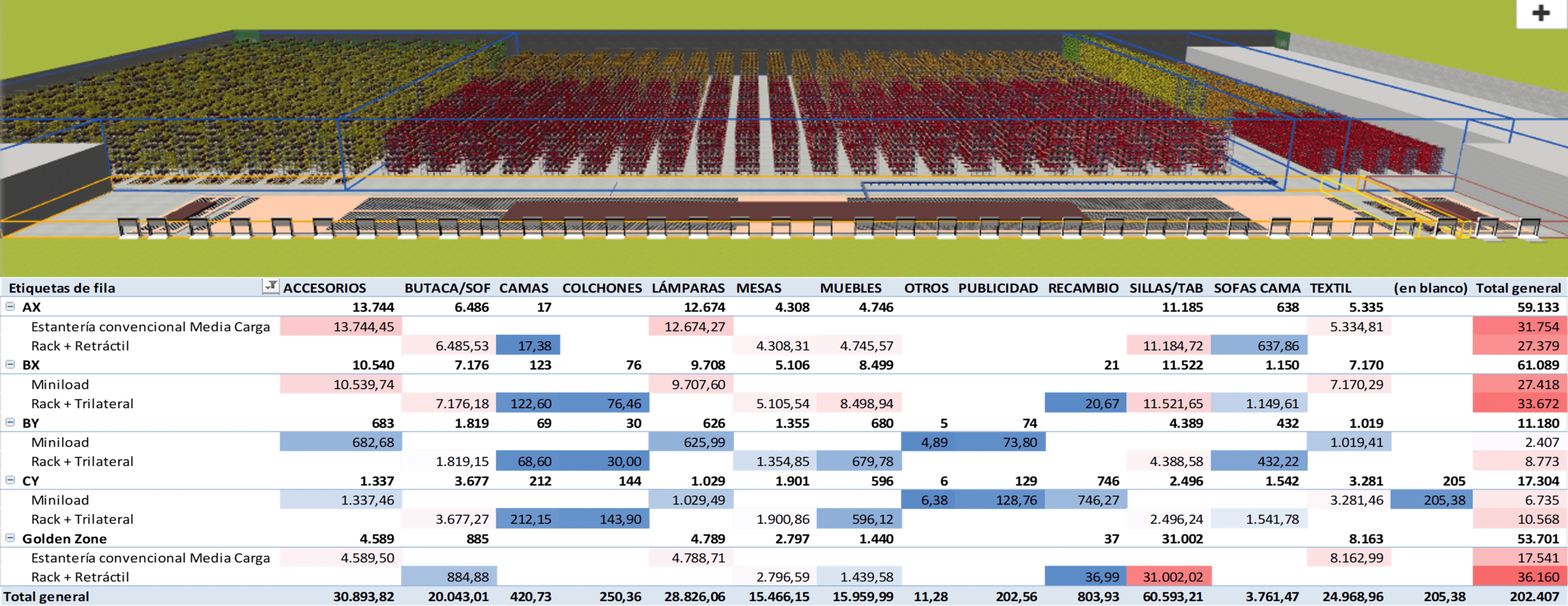
We develop a model that will be fed by WMS data to understand references, locations, etc. Additionally, we connect to the ERP to know both incoming orders (purchases) and their status (in transit, pending, others) and outgoing orders and their status. By accessing sales data, we develop a predictive model on which to base future optimization or detect potential bottlenecks. We also add relevant external variables to the prediction. With all this, we generate an AI-powered reslotting improvement engine that can return results to the WMS so that it generates the relevant work orders or makes changes to the slotting-related variables in location or product masters.
How We Do It
Data connections and storage.
Relevant integrations are carried out with the necessary data sources. External variables to be included are studied, and an intermediate repository (Data Warehouse) is generated where the prepared information for analysis is stored.
Intelligence layers.
We utilize leading market tools and technologies for Advanced Analytics and Artificial Intelligence to develop the model. Data is transferred at the established frequency, and both demand predictive models and slotting optimization engines are developed.
Visualization and integrations.
The final result will be visualized in a market BI tool, or sent directly to the client’s system (WMS) responsible for performing the necessary tasks for the optimized process.