
KNIME: Data Science Without Programming
We have already mentioned KNIME on another occasion, a tool that helps us create Data Science platforms in a simple and intuitive way by working with ETL (Extract, Transform and Load) data flows, structured in tables (rows and columns). It is capable of making a complex technology such as Big Data understandable and manageable for any type of company profile.
The adjectives “simple” and “intuitive” that we mentioned in the opening lines of this post were not chosen at random, as this tool’s potential uses go beyond the pure data management processes that we will look at later. By being based on a GUI (Graphical User Interface), KNIME offers a natural graphical interface that makes it possible to work in Data Mining environments without programming knowledge.
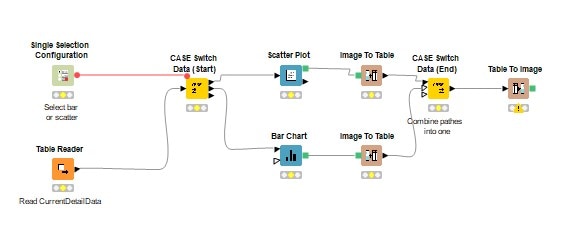
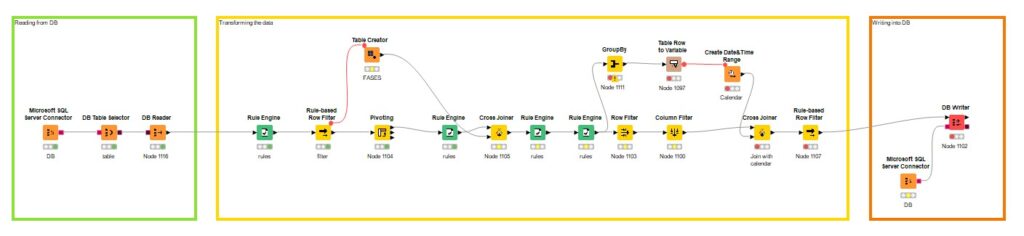
In this regard, the stars of KNIME are the nodes, visually represented by “little boxes” through which data passes so that the desired actions can be applied. Each node performs an operation on our data, achieving a complete flow with interconnected nodes (Figures 1, 2 and 3). One of the major advantages of this way of working compared to lines of code is that we can see the intermediate steps in each transformation at a glance.
In addition, KNIME provides users with extensive, detailed documentation for each node and includes example flows to illustrate this information.
Complete ETL with KNIME
Returning to its potential in data management, the tool we are analysing makes it possible, as we have already noted, to build a complete ETL flow. Let us look at the options it offers:
- Connection to all kinds of data sources: Databases such as Oracle, Microsoft SQL or even Azure, text files such as Excel, CSV, JSON, etc.
- Processing of extracted data: KNIME allows all kinds of modifications to our data, from filtering rows and columns, joining information from different tables, performing operations between columns, or even grouping rows. In this way, we can cleanse the data and leave it ready to load into the same or another target source.
- In addition to processing and transforming data, KNIME also allows advanced analytics techniques to be applied to it, to extract all kinds of statistics from that data.
- On the other hand, we can go one step further by generating Machine and Deep Learning models, such as decision trees or even neural networks, from a training dataset, and making predictions on a test set.
- It is possible to evaluate the accuracy of the models created using scoring techniques.
- It is possible to generate charts showing the results obtained.
- The final data can be loaded back into a database, or written to CSV text files.
- Developments created with KNIME can be shared, so that they can be reused by another user.
- They can also be put into production; that is, the flow can be exported and run automatically on a periodic basis, so that we can feed a database with periodic results.
As we can see, KNIME is an intuitive and simple tool with enormous potential due to its ease of integration and scalability; its simplicity when it comes to orchestrating complex data flows from which to extract valuable insights; its ability to build Machine Learning models in just a couple of clicks; the strong support network provided by the software itself and the community built around it; its rapid learning curve… in short, its ability to make the difficult easy.
Conclusion
In conclusion, we could say that KNIME Analytics Platform is an open-source, user-friendly tool that enables the development of data transformation (ETL) flows in a simple way, without the need to program. In this regard, one of its main strengths is that it offers a wide variety of nodes to carry out everything from loading and transforming data to developing Machine Learning models and subsequently loading them into a repository. In addition, as an advantage over lines of code, it makes it possible to check the intermediate state of the data as transformations are performed, without these changes taking effect in the database until they are written to it.