
Industry 4.0 Case Studies
After explaining “What is Industry 4.0,” we have presented some of the most significant aspects of the digital revolution that is impacting production environments.
Below, we present some practical application cases of these technologies.
Elevator Data in the Cloud
A company specializing in elevator design and installation has developed a solution for real-time predictive maintenance based on the Cloud.
This solution combines IoT, Cloud, Big Data, and Artificial Intelligence technologies, aiming to reduce downtime through real-time diagnostics.
Data such as door movements, trips, starts, calls, errors, etc., are collected by sensors before being sent to the Microsoft cloud (Azure), where an algorithm calculates the remaining useful life of the main components and identifies components that need to be inspected or replaced. The prediction is made by comparing the elevator’s operating variables with data from other installations that already have a historical record.
This information is sent to maintenance technicians so they can monitor the status of each elevator in real time.
The power of this solution lies in its ability to compare the operational status of thousands of installations, thus providing a large volume of cases to generate statistically significant values.
It is estimated that this company will reduce downtime by 50%, in addition to reducing maintenance costs and associated planning costs.

LIS Predictive Maintenance
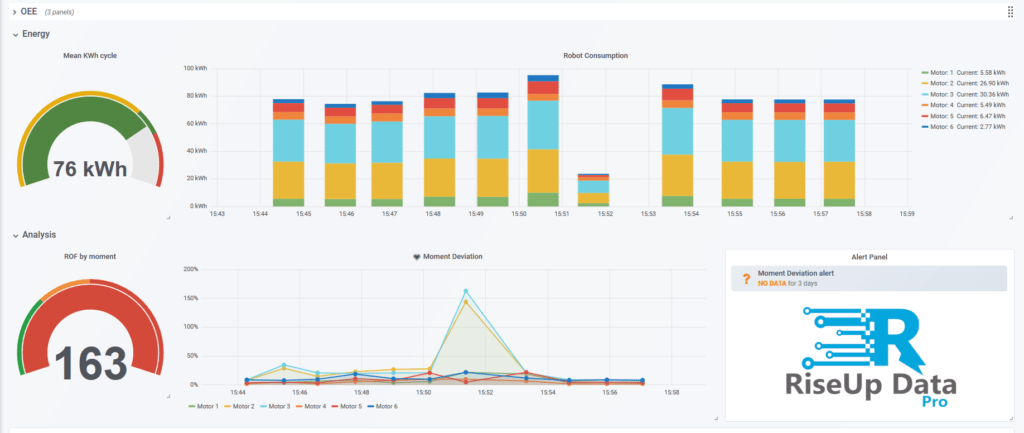
Continuing with predictive maintenance, LISDATA has developed a tool for the predictive maintenance of robots on a production line for a major automotive sector company.
Data transmitted by the robots’ PLCs on the line are stored in databases, along with historical fault and incident records.
Machine Learning tools are used to correlate incidents with robot operating variables: torque, current consumption, speed, and acceleration. This correlation is achieved by training an algorithm that, based on historical data, identifies patterns of values that manifest before a failure occurs.
Once alarm values are identified, the tool constantly monitors the robots on the line, calculating the Remaining Useful Life (RUL), Risk of Failure (ROF), and Overall Equipment Effectiveness (OEE) for each.
For example, if at a given moment a robot requires more current (under otherwise equal conditions) to perform the same task, this indicates an operational anomaly, and the system sends an alarm.
Optimizing Worker Ergonomics
An automotive sector company has factories in Germany where some operations are performed manually due to the small size of the parts and the characteristics of the tasks to be carried out.
The plant has 400 manual workstations, and the workforce consists of approximately 350 employees.
The project’s objective was to develop a tool to help production managers distribute tasks among workers, considering the nature and difficulty of the task, worker characteristics (age, experience level, specialization, physical limitations), and the presence of work shifts.
Physical limitations refer to a worker’s inability to perform certain movements: lifting more than a specific weight, extending an arm above a certain height, standing for more than a determined period, etc.
By cross-referencing databases related to workers and their shifts, physical limitations, and tasks with their associated physical load, it was possible to identify which tasks to assign to each worker, respecting the imposed conditions.
Share on facebook
Share on google
Share on twitter
Share on linkedin
Share on pinterest
Share on print
Share on email