
Digital Twins for Industry 4.0
At LISDATA we deliver production simulation projects within the Industry 4.0 concept – Digital Twin.
A replica of a real process in a virtual environment
There is no greater power than predicting the future. Once turbulent times have passed, and we find ourselves in one with impacts unknown to date, conditional statements always come to the fore: if only… But these verb tenses, as their name suggests, start from a condition that was not met—something that, with time, is easy to identify, but at the moment it happened, it was not. As popular wisdom says, “with hindsight…”
With hindsight, we all know what we should have done, but it is no longer useful because we cannot go back in time. We cannot go back… but now we can anticipate what may happen and rehearse our response. It sounds like science fiction, but it is not; it is one of the many opportunities to improve business efficiency that Industry 4.0 brings us.
DIGITAL TWINS
SIMULATIONS TO MAKE PREDICTIONS
They are used to learn in the virtual environment and transfer that knowledge to the real environment
What are digital twins and what do they enable?
Artificial Intelligence enables us to create an avatar of operational processes with which to rehearse responses to complex scenarios. These allies are called digital twins, and they are used to learn in the virtual environment and transfer that knowledge to the real environment. They are considered a disruptive technology in the simulation and analysis of industrial processes and have also been identified by Gartner as one of the 10 technologies that will drive companies’ digital transformation and their journey towards Industry 4.0.
These virtual environments make it possible to monitor, test algorithms, simulate stoppages, downtime, and much more—in other words, to emulate a real environment, which does not have to be the current one, since we can carry out critical developments in our digital twin, reducing risks to zero.
Digital twins are imperative for developing a new process, improving an existing process, or developing new services.
The learnings acquired in virtual environments—digital twins—are easily implementable in real environments.
Examples of digital twins
Can you imagine having a test bench where you can easily simulate the most varied day-to-day scenarios of a company? Digital twins allow us to safely explore different scenarios and prepare for future situations that may put our ability to respond to the test. What would happen if we had to meet demand 10% above our average? Would I have the capacity? Which flows would be affected? Which machines would be overloaded and which underutilised?
And if, during this hypothetical day, in addition to all the tensions that have already arisen, a machine stops working and we face a stockout of high-turnover parts. How long would it take me to recover from this fateful day? And at what cost?
This is one of the many situations that can be simulated through digital twins. At LISDATA, we generate virtual environments so that, little by little, business experts can create scenarios in which they can test their estimates, experience, and intuition. It is a game that provides the process owner with all available information to develop their planning recipes.
“The transition from an analogue scenario to a digital twin has intermediate learning phases, both for the user and for the response algorithms.”
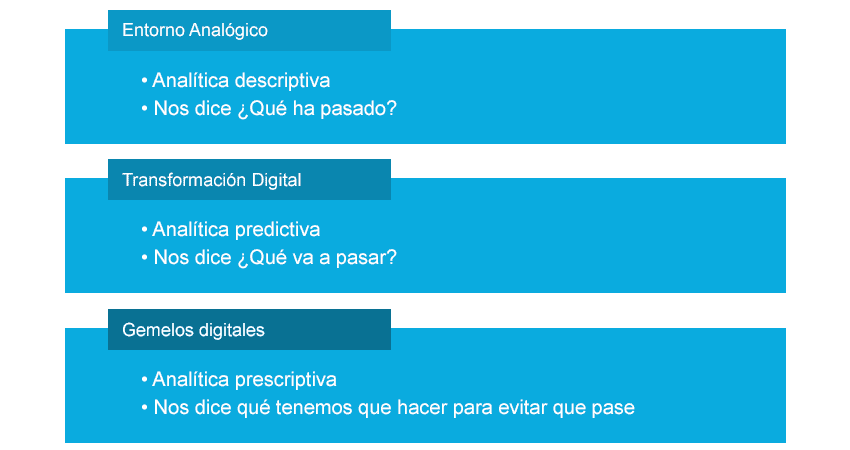
How LISDATA develops these projects and how our clients benefit from them.
First, a general study of each client’s business must be carried out.
At LISDATA, we have consultants with many years of experience in the study and optimisation of production, logistics, purchasing, warehousing, transport processes, etc.…
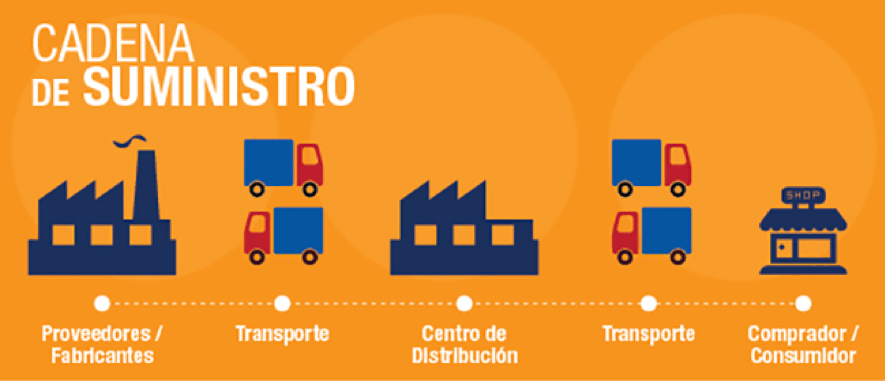
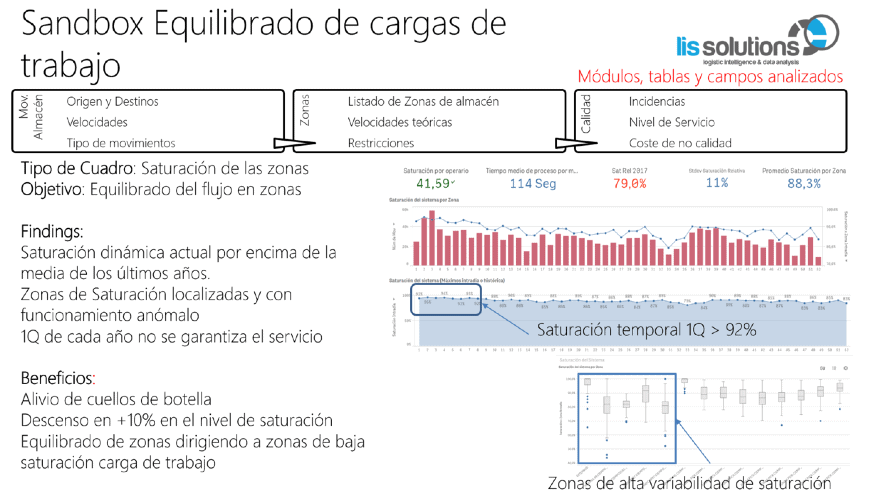
As a second phase, the complexity of the digital twin must be identified.
At LISDATA, we always recommend starting by including processes from 1 or 2 departments and then gradually increasing complexity.
This is the part where, once again, our business experts and Big Data experts join forces to define digital environments that reflect business reality without losing sight of analysis and simulation capabilities.
This is the phase where “What If” models come into play—for example, sliders to simulate future events, or defining the KPIs and charts that should reflect that virtual environment.
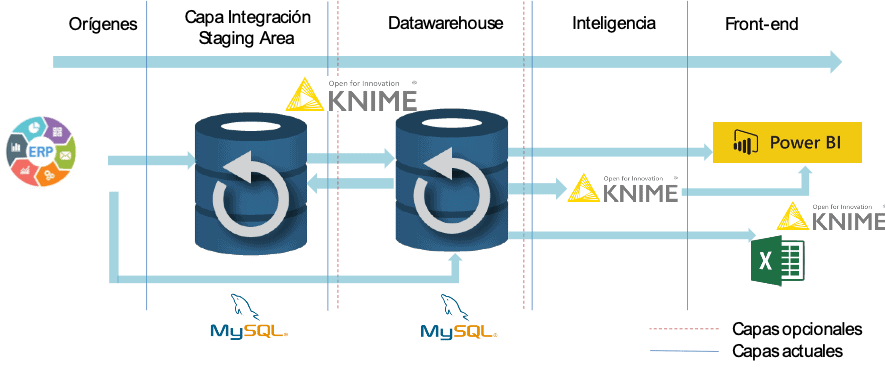
In a third phase, data extraction, processing, and loading are carried out.
All information from the different databases within the company is processed to feed the digital twin. This entire data “pressure cooker” must contain clean, reliable information, as it will determine what some of our clients refer to as “the single source of truth.”
In the fourth phase, Artificial Intelligence appears.
At this point, our mathematicians model algorithms that predict future events, correlate thousands of variables, and interpret the information. At this stage, the business expert ‘teaches’ the twin to make the best decisions so that, when an unexpected event occurs, the algorithms will suggest the most appropriate ‘routes’ to reduce the event’s impact. The idea is to create a Google Maps that tells us the optimal path if an accident or traffic jam is detected.
Por último, se crean entornos gráficos en los que toda esta información pueda ser fácilmente procesable. Actualmente desde LISDATA migramos toda esta inteligencia a Cuadros de Mando o Dashboards en tecnologías como Qlik, Tableau, Power BI e incluso en entornos de SAP BW.
En un futuro próximo (actualmente ya estamos desarrollando pilotos) los gemelos digitales serán majeados en entornos inmersivos, donde la Realidad Virtual y la Realidad Aumentada ayudarán a los expertos de negocio a poder procesar decenas de indicadores y tener una imagen más clara de los ecosistemas complejos que le rodean.
Ultimately, a digital twin allows us to ‘play’ with our business without risk and run thousands of trial-and-error tests, from which the scenario itself will learn. This evolution makes day-to-day business operations easier to manage, freeing up time to think tactically and strategically, while robots act as ‘firefighters’.
DIGITAL TWINS