
Databricks in 2026: The Strategic Pillar of the Data-Driven Enterprise
In the volatile environment of 2026, an organization’s ability to survive and lead does not depend on how much data it accumulates, but on the speed and security with which it transforms that data into profitable decisions. For technology and business leaders, the challenge is no longer infrastructure, but fragmentation: data silos, uncontrolled cloud costs, and artificial intelligence that often remains in the experimental phase.
Databricks has evolved from a niche tool into the operating system of the modern enterprise. By unifying data engineering, analytical storage, and generative AI into a single open architecture (Lakehouse), it enables your organization to stop managing complex systems and focus on generating competitive value.
In this article, we break down why Databricks is now the key component for optimizing your technological ROI, democratizing access to information, and scaling innovation with comprehensive governance.
The Consolidation of the Data Lakehouse as an Operational Standard
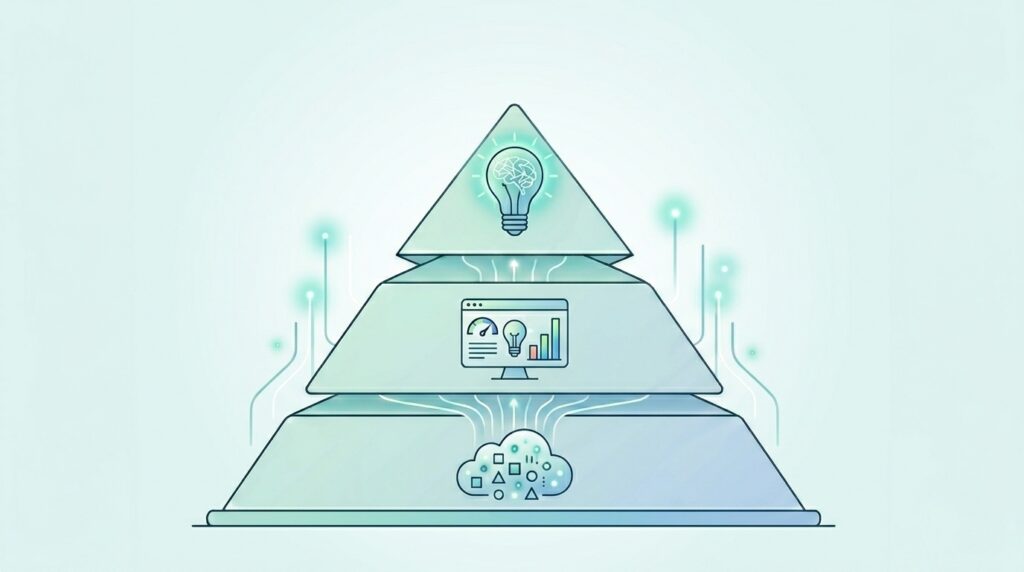
In 2026, the distinction between a Data Warehouse (for structured analytics) and a Data Lake (for data science) has become obsolete. Databricks’ Lakehouse architecture has become the standard because it eliminates data redundancy and operational silos that previously hindered innovation.
This translates into three fundamental pillars:
-
Infrastructure Simplification: You no longer need to maintain two critical systems or pay to move data between them (complex ETL). Everything resides in a single location under open standards like Delta Lake.
-
Response Agility: By having engineering and business data on a single platform, the time from data generation to decision-making is drastically reduced.
-
Open Architecture: Unlike closed solutions, the Lakehouse ensures you own your data. This prevents vendor lock-in and allows for seamless integration of third-party tools.
The Lakehouse is not just a technical improvement; it eliminates internal friction. If your analytics and AI teams don’t speak the same “data language,” your company is losing speed to the competition.
Mosaic AI: Deploying Generative Artificial Intelligence with Proprietary Data
In 2026, generic AI no longer offers a competitive advantage. The true value lies in Mosaic AI, Databricks’ suite that enables companies to train and fine-tune Large Language Models (LLMs) using their intellectual property securely.
Unlike “black box” solutions, Mosaic AI facilitates RAG (Retrieval-Augmented Generation) at scale, ensuring that AI responses are anchored in your business’s real data and not in hallucinations.
-
Total Customization: Train models with your technical terminology and historical data.
-
Guaranteed Privacy: Your data never leaves your governed environment to train third-party models.
-
Inference Efficiency: Cost optimization so that deploying a smart assistant does not skyrocket your computing bill.
Unity Catalog: Comprehensive Governance and Security in Multi-Cloud Environments
In the 2026 technological landscape, Unity Catalog has solidified its position as the definitive solution for managing data and artificial intelligence in hybrid cloud architectures. Today’s organizations operate in complex ecosystems and require centralized control to prevent security breaches.
Unity Catalog eliminates the complexity of fragmented permission management and offers a clear view of the entire data estate.
Unified Control for Data and Artificial Intelligence
Unlike traditional governance tools, Unity Catalog allows you to manage permissions for tables and language models from a single access point. This capability ensures that compliance policies are consistently applied across the entire enterprise structure. The system enables auditing of who accesses information and ensures that only authorized personnel interact with sensitive assets.
Automated Traceability and Lineage
Data lineage provides the exact journey of information from its initial capture to the final business report. This function is fundamental for complying with international data protection regulations and for validating the quality of AI-generated results. Thanks to this transparency, technical teams can identify the source of any anomaly in seconds.
Secure Collaboration via Delta Sharing
The Delta Sharing functionality facilitates the real-time exchange of data assets with external vendors and clients. This process is conducted securely and does not require creating physical copies of information in other systems. By using open standards, seamless collaboration is fostered, driving innovation without compromising intellectual property.
Governance in 2026 is no longer an obstacle to agility. With Unity Catalog, regulatory compliance transforms into a strategic advantage that generates absolute confidence in decision-making processes.
Databricks SQL: Democratizing Access to Real-Time Insights
Currently, the barrier between data storage and business analytics has completely disappeared. Databricks SQL allows analysts and decision-makers to query the Lakehouse directly with the performance of a traditional data warehouse. It is no longer necessary to move information to external systems to get quick answers.
This technological evolution ensures that data is available to those who truly need it, without relying on constant export processes.
Elite Performance with the Photon Engine
The Photon engine has redefined speed expectations in query processing. Thanks to its vectorized execution, aggregation and filtering tasks are performed in milliseconds, even over petabyte volumes. This efficiency eliminates the waiting times that previously hampered the productivity of financial or marketing departments.
Simplicity through Serverless Architecture
Databricks SQL’s Serverless mode eliminates the need to configure or manage complex infrastructures. The system automatically scales to absorb demand peaks and shuts down when no activity is detected. This true pay-as-you-go model allows for absolute budget control without sacrificing responsiveness to unforeseen events.
Integrated AI Functions for All Profiles
One of the greatest current innovations is the ability to invoke artificial intelligence models using simple SQL commands. Users can perform sentiment analysis or text classifications without writing Python code. This integration puts the power of advanced AI into the hands of any professional with basic database knowledge.
Democratic access to information reduces friction between departments. In 2026, a company that takes days to obtain a report is a company that cannot compete in a market that moves in seconds.
TCO Optimization: Maximizing Cost Efficiency at Scale
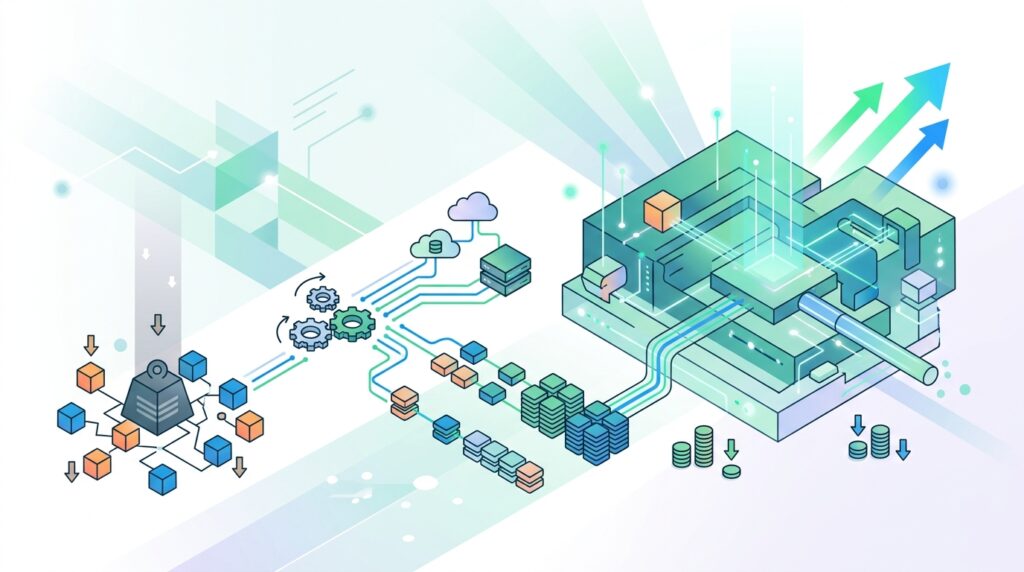
Economic pressure forces companies to justify every penny of their cloud investment. Databricks has evolved to offer a platform that is not only powerful but also financially sustainable in the long term. Efficiency in Total Cost of Ownership (TCO) is achieved through automation and radical simplification of the data architecture.
Serverless Computing and True Pay-Per-Use
Clusters that remain on without performing productive tasks are a thing of the past. Serverless computing scales instantly according to demand and shuts down the exact moment processing finishes. This capability eliminates unnecessary spending on idle resources that used to inflate monthly infrastructure bills in the past.
Tool Consolidation and ETL Process Reduction
Maintaining a single platform for data engineering and analytics eliminates the need to move information between heterogeneous systems. By working on the Lakehouse, storage costs are saved by avoiding data duplication, and licensing costs are reduced by decreasing the number of specialized vendors. Less data movement also means fewer errors and a direct reduction in required technical maintenance hours.
Photon’s Impact on the Computing Bill
The Photon execution engine drastically accelerates workloads through vectorized processing. By processing data faster, fewer billable computing hours are consumed from the cloud provider. This technical efficiency translates into operational cost savings that can reach up to 40% in large-scale processes compared to traditional infrastructures.
Reducing TCO is not simply about spending less. The real goal is to eliminate operational waste to reinvest that capital into innovation and artificial intelligence projects.
2026 Roadmap: How to Transform Your Stack into a Competitive Asset with Databricks
Transitioning from a fragmented data infrastructure to a unified platform is not a purely technical process. In 2026, success depends on phased execution that aligns technological architecture with the company’s profitability objectives. A smart roadmap prioritizes eliminating technical debt while enabling generative artificial intelligence capabilities immediately.
Phase 1: Silo Audit and Migration to Delta Lake
The first step involves identifying where critical information resides and consolidating it under the open Delta Lake standard. This phase eliminates the need to maintain isolated systems and ensures that data has the necessary quality to feed AI models. By unifying storage, a solid foundation is established that allows simultaneous access for predictive analytics and data science without version conflicts.
Phase 2: Automation of Governance and Compliance
Once assets are centralized, Unity Catalog must be implemented to manage security automatically. At this stage, the organization defines who has access to what data and monitors the complete lineage of information in hybrid cloud environments. This control structure is fundamental for complying with current privacy regulations and for ensuring that artificial intelligence operates on truthful and authorized data.
Phase 3: Activation of Proprietary Artificial Intelligence
With a governed database, the focus shifts to creating value through Mosaic AI. This phase involves fine-tuning language models with the company’s intellectual property to solve specific business problems. The goal is to integrate intelligent assistants and automated processes that improve real-time decision-making and offer a sustainable competitive advantage over those using generic solutions.
Strategic deployment in 2026 requires a clear vision of costs and benefits. A phased implementation ensures that every investment in Databricks translates into a measurable improvement in operational efficiency.
Why Trust LISDATA as Your Databricks Partner
The implementation of an architecture as powerful as the Lakehouse in 2026 requires an ally that combines technical mastery with a deep understanding of the business landscape. At LISDATA, we don’t just configure tools; we design data ecosystems aimed at maximizing your profitability and innovation capacity.
Having a specialized partner ensures that the transition to Databricks is smooth and generates measurable results from the early stages.
Vertical Specialization in Logistics and Industry
Our experience as specialists in logistics, industrial, and transportation consulting allows us to understand the specific challenges of your sector. We apply vertical solutions that solve real supply chain and production problems through advanced data analysis. This sectoral vision ensures that the Databricks architecture adapts to your business’s operational needs, not the other way around.
Custom Projects with an End-to-End Approach
We develop tailor-made projects that cover the entire information lifecycle: from initial capture and processing in the Lakehouse to data activation through AI. This comprehensive approach ensures there are no communication gaps between data engineering and strategic decision-making. Each solution is built with scalability in mind and aims to create high-value digital assets for your company.
Rapid Implementation and Results-Oriented Approach
In today’s volatile environment, execution speed is a critical competitive advantage. We stand out for our rapid implementation of technological solutions, enabling our clients to achieve tangible benefits in reduced timeframes. Our high technical specialization is combined with a constant strategic vision to ensure that every development directly impacts the bottom line.
The success of Databricks in your organization depends on the strategy that supports it. At LISDATA, we work to transform your data investment into tomorrow’s leadership. Can we help you?