
Data Spaces Kit: Complete Guide to Get Up to €30,000
The economy of the future is no longer based solely on collecting data, but on knowing how to share it securely and strategically. To drive this new era, the Government has launched the Data Spaces Kit 2026, an initiative that offers companies grants of up to €30,000 to integrate into shared data ecosystems.
If you are wondering how this grant can transform your business and, most importantly, how to access it without getting lost in bureaucracy, you are in the right place. At LISDATA, we are experts in making data work for you, and we support you throughout the entire process. We will explain how you can access the Data Spaces Kit 2026 and obtain up to €30,000 for your company.
-
Who? Public and private entities.
-
How much? Up to €30,000 if you act as a Data Provider, or up to €15,000 if you participate as a Participant.
-
How? Through LISDATA, where we handle the technical development of the connector, secure storage, the use case, and full support in justifying the grant.
-
When? The award deadline is March 31, 2026.
What is the Data Spaces Kit 2026 and how does it benefit your company?
The Data Spaces Kit 2026 is a public grant initiative designed to accelerate the sovereign digitalisation of Spanish companies. It is a non-repayable grant programme that aims to encourage organisations to integrate into shared data ecosystems, enabling public and private entities to collaborate in a trusted environment.
Unlike other basic digitalisation grants, this Data Spaces Kit focuses on the collaborative data economy. The goal is for companies to stop working in isolated silos and start participating in a larger ecosystem or observatory, fully secure and with controlled access.
How do Data Spaces benefit your business?
Joining a data space through this grant provides immediate competitive advantages:
- Sovereignty and Security: Thanks to European standards, you retain full control over who accesses your information and under what conditions.
- Access to Shared Knowledge: It enables a richer view of your sector through the analysis of anonymised data, fostering co-creation and innovation.
- Tactical-Strategic Decisions: Access to ecosystem information facilitates the creation of advanced predictive systems that optimise competitiveness.
- Removal of Technical Barriers: The grant covers the infrastructure needed so that communication and cooperation with other market players is smooth and frictionless.
- Synergies and Cooperation: Collaborate with partners in your value chain (suppliers, logistics, customers) to optimise shared processes.
- Asset cleansing: The onboarding process requires you to clean and organise your data, turning it into real assets ready to be leveraged.
Beyond the technical infrastructure, the true revolution of Data Spaces lies in transforming business culture towards a model of collective intelligence. By integrating into this ecosystem, your business stops operating based on assumptions or fragmented data and starts acting with a real, up-to-date market view. This collaboration makes it possible to identify new monetisation opportunities and business models (such as buying and selling data assets or premium analytics services) that were previously inaccessible individually.
In addition, this process acts as a catalyst for the organisation’s digital maturity: by being driven to cleanse and structure your internal assets, you eliminate long-standing inefficiencies and prepare your architecture for the deployment of advanced Artificial Intelligence. Ultimately, this is not just about meeting a technological requirement, but about positioning your company at the centre of a more resilient logistics and commercial network, where information flows to predict bottlenecks, reduce operating costs, and respond with extreme agility to the demands of today’s industrial market.
How can I benefit from the €30,000 from the Data Spaces Kit 2026?
The amount of the grant is not an end in itself, but rather the financial backing for the level of digital maturity your company needs to achieve. If your strategy is to strengthen your internal architecture and become a reliable source of information for your business partners, the grant reaches €30,000 under the Provider role. This upper tier is designed to fund robust connection infrastructure and a deep cleansing of your assets, ensuring that your information is shared only with whom your company decides and under European standards, without ever losing sovereignty over your business.
For organisations that prefer an initial approach or whose main interest is consuming external intelligence and accessing sector dashboards, the programme offers a grant of up to €15,000 under the Participant role. At LISDATA, we assess your use case to identify which of these two paths best aligns with your technical objectives, ensuring that, whichever amount you choose, the integration is agile, secure, and backed by our experience in justifying public grants.
Use cases: How does a Data Space translate into real profitability?
If you are wondering what exchanging data is for in your day-to-day operations, the answer is simple: to stop making decisions based on intuition. In the industrial sector, data spaces are solving long-standing problems through intelligent collaboration under sovereignty rules.
Thanks to the technology we implement at LISDATA, these are the scenarios where your company will start to notice the difference:
- 360° Supply Chain Visibility: No more lack of information about your suppliers. By integrating your sources with those of your logistics partners, you gain real-time traceability and route optimisation. This eliminates biased views and enables production to be coordinated based on the actual availability of materials.
- Predictive Maintenance and Synergies: Imagine training AI algorithms not only with your data, but with the shared value of aggregated sources from your sector. This increases accuracy in anticipating failures without you ever having to reveal your industrial secrets or move the data from its origin.
- Strategic Dashboards and Benchmarking: We connect industry providers to generate prediction services and result consumption. This enables companies to access a federated catalogue of assets and metadata to identify market trends with extreme agility.
- Asset Cleansing and Valorisation: Simply preparing to enter a data space forces you to organise your information. What used to be “noise” becomes a real, structured asset, ready to be leveraged or even monetised in a marketplace.
Precedent: Your demonstration centre for secure and sovereign Data Spaces
For a data space to be functional, it requires technical infrastructure that acts as an “arbiter” and ensures that no one loses control over their information. This is where Precedent, the advanced platform developed by LISDATA, comes in, acting as a Data Spaces Demonstration Centre.
Trust in this ecosystem is certified: our activity is backed by ISO 27001 certifications (Information Security) and ISO 9001 (Quality Management), and is also fully aligned with the National Security Framework (ENS) and strict GDPR compliance.
Precedent is a decentralised ecosystem designed to connect companies, suppliers, and customers in an environment of trust and absolute security. Unlike traditional storage solutions, Precedent does not centralise your files in a third-party cloud; instead, it enables a network of nodes where each participant retains physical custody of their assets. It is the tool that makes Digital Sovereignty a reality: it allows data to communicate with each other to generate business, but under the strict rules of the party that generated it.
Hardened Security: “My data, my rules”
The fear of losing control over industrial secrets or commercial margins is the biggest barrier to collaboration. In Precedent, we have eliminated this risk through a security-by-design architecture:
-
EDC Connectors (Eclipse Dataspace Components): We implement the most advanced European standard. These connectors act as “smart customs”: the data never leaves your infrastructure unless there is a prior digital contract that validates the recipient’s identity and the specific authorised use.
-
Verified and Decentralised Identity (Identity Hub): There is no anonymity. Each entity has a certified digital identity. Before any exchange, the platform verifies through trust protocols that the counterparty is who they claim to be, eliminating any risk of impersonation.
-
Binding Digital Contracts: You define the “who”, the “when”, and the “what for”. You can configure usage policies so that your data is only used for a specific AI training or a logistics query, and that access automatically expires once the objective has been met.
-
Full Traceability (Clearing House): All transactions leave an immutable, auditable trail. This makes it possible to know at all times who has consulted which information, ensuring full transparency between business partners.
Tactical Value and Advanced Computing Capability
Precedent is not just a secure “tunnel”; it is where data is transformed into a competitive advantage:
-
AI at the Source: One of Precedent’s most powerful capabilities is that it allows the algorithm to be sent to the data, not the data to the algorithm. We can deploy language models (LLMs), optimisers, and digital twins that analyse information locally and only return the result of the computation, protecting raw data at all times.
-
Datasink Service and Enrichment: For companies that prefer not to manage their own servers, we offer Datasink, secure storage with guaranteed sovereignty. In addition, we enrich your analyses by cross-referencing your internal data with exogenous variables (weather, market prices, traffic) from our own Datalake.
-
Native Interoperability: We break down information silos. Precedent enables systems from different companies to “speak the same language” automatically, facilitating ecosystems such as the HABITAT Data project, where the value chain collaborates in real time to reduce costs and predict demand.
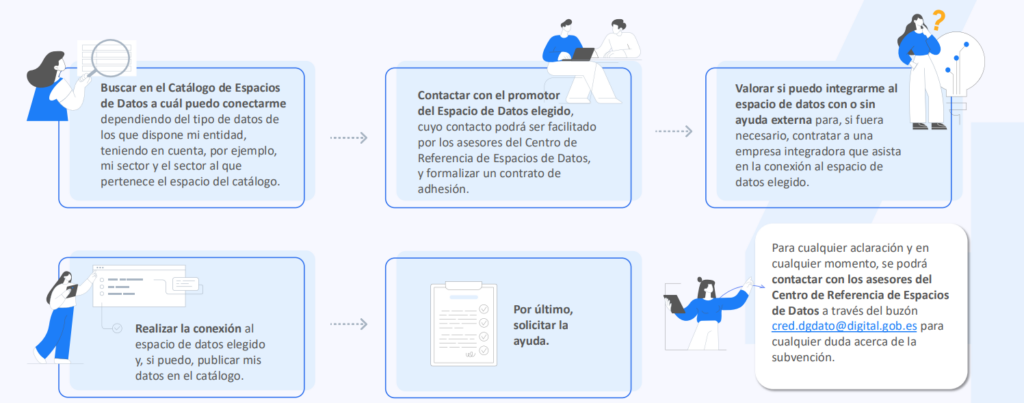
How to apply for the Data Spaces Kit with LISDATA
We understand that managing grants and implementing cutting-edge technologies can seem complex. For this reason, at LISDATA we have designed a comprehensive support model so that your company does not have to worry about bureaucracy or technical complexity:
-
Strategic Advisory and Role Definition: In addition to strategic advice on how your company can maximise the benefits of Data Spaces, we analyse your business model to identify which option will deliver higher revenue, validating whether your optimal fit is as a Provider (grant of up to €30,000) or as a Participant (grant of up to €15,000).
-
Technology Implementation with Precedent: We deploy EDC connectors, manage your digital identity, and configure usage policies so that your current systems can “speak” natively with the data space, ensuring interoperability without silos.
-
Administrative Management and Justification: We process the application and support the technical justification report. Thanks to our certifications and experience, we minimise the risk of requests for corrections, ensuring that you receive and retain the grant with full legal certainty.
It is essential to bear in mind that the award deadline for these grants ends on March 31, 2026. Since configuring sovereign connectors and auditing assets require prior planning, we recommend starting the process as soon as possible to secure the funds. Email us at precedent@lisdatasolutions.com for more information, and our team will be pleased to help you.
Frequently Asked Questions about the Data Spaces Kit (FAQ)
Entering the data economy creates major opportunities, but also logical questions about security and control of information. Below, we answer the most frequently asked questions we receive at LISDATA about the new Data Spaces Kit 2026. Our goal is to clear up technical and legal uncertainties so that your company can take advantage of these European grants with maximum confidence, ensuring that technology always works in favour of your business objectives.
Do I have to give up ownership of my data to receive the grant?
Absolutely not. The foundation of a data space is sovereignty. Unlike a conventional cloud, you do not “upload” your files to a third-party platform. The data remains on your servers and is only shared on demand through digital contracts that specify who can see it and for what exact purpose.
Do I need my own server infrastructure to access the grant?
No. One of the major advantages of working with LISDATA is that we remove the barrier of hardware investment. If your company does not have servers or complex IT infrastructure, we provide our Datasink service. It is secure, external storage that meets all sovereignty requirements and European regulations, enabling you to participate in the data space without hidden infrastructure maintenance costs.
How does the Data Spaces Kit ensure that my competitors do not use my information?
This is the most common question, and the answer lies in sovereignty technology. Through our Precedent platform, you configure granular access rules:
Verified Identity: Only the entities you explicitly authorise can view your data.
Usage policies: You can restrict certain competitors from viewing sensitive assets or limit the use of information to very specific purposes (for example, only for aggregated calculations where your individual data cannot be identified).
Digital Contracts: The system automatically blocks any access attempt that does not comply with the legal and technical terms you have digitally signed.
Is the Data Spaces Kit compatible with the Digital Kit?
Yes, they are 100% compatible grants. While the Digital Kit focuses on basic digitalisation tools (such as CRM or websites), the Data Spaces Kit funds the advanced infrastructure needed for interoperability and shared value between companies. It is the strategic next step for SMEs that have already started their transformation and want to monetise or protect their information assets.
What exactly is data sovereignty and why is it key for my business?
Data sovereignty means that control always remains at the source. In the context of sovereign data spaces, you do not “upload” files to a public cloud where you lose track; you expose your assets under your own rules. This is vital for industrial companies that want to innovate with AI without exposing their trade secrets or operational know-how.
What is the deadline to apply for the Data Spaces Kit?
The grant programme is open, but the final deadline for awards is March 31, 2026. It is important to note that funds are limited and the process requires a prior audit of your assets and the configuration of EDC connectors. For this reason, we recommend starting the application as soon as possible to secure the amount (up to €30,000).
What is the difference between the Provider and Participant roles in the Data Spaces Kit?
The difference lies in the direction of the data flow and the amount of the grant. The Provider (up to €30,000) is the one who makes their assets available to the ecosystem (with full control), while the Participant (up to €15,000) is the one who accesses that data to enrich decision-making. A company can perform both roles simultaneously.
Who can apply for the €30,000 grant from the Data Spaces Kit?
The maximum amount of €30,000 is intended for companies that take on the role of Data Provider. This profile is ideal for organisations that have valuable information assets and want to lead a sector ecosystem. For companies that only seek to consume external intelligence (Participants), the grant is up to €15,000. At LISDATA, we help you determine which role maximises your return on investment.
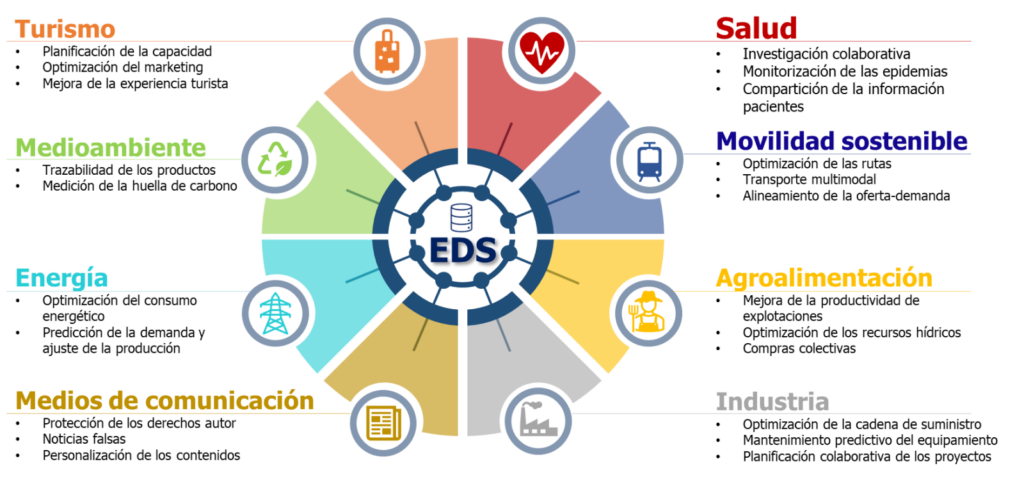
Which sectors benefit most from Data Spaces?
Any sector with a complex value chain can obtain immediate benefits. Notable examples include Industry 4.0 (predictive maintenance), logistics (traceability and route optimisation), and the furniture sector (as in our success case in the HABITAT Data project), where collaboration between suppliers and manufacturers drastically reduces operating costs.