
Claude vs. ChatGPT in 2026: Which AI Should You Choose for Your Company?
In 2026, artificial intelligence (AI) has ceased to be a chat assistant and has become the core of enterprise architecture. With the almost simultaneous launch of GPT-5.3 Codex and Claude 4.6 Opus, the competition between OpenAI and Anthropic has shifted from “creativity” to operational autonomy. In this article, we objectively analyze which ecosystem offers the technical, security, and efficiency guarantees necessary to lead your sector, integrating key concepts such as MCP, Prompt Caching, Data Spaces, and digital sovereignty.
What is happening with OpenAI and Claude in 2026? The state of agentic AI
The current state of the sector is marked by the transition from co-pilots (assisting humans) to AI agents (executing processes autonomously). While OpenAI has consolidated a massive multimodal platform, Anthropic has established itself as the reliability standard for complex corporate environments.
Claude Opus 4.6 vs. GPT-5.3: Performance comparison in logical reasoning and coding
This year’s benchmarks have revealed a clear functional specialization that every professional must know when making decisions:
- Claude Opus 4.6 (Anthropic): The standard in systemic reasoning. According to the latest reports from Artificial Analysis, Claude 4.6 maintains a score of 94.2% in the GPQA benchmark (Graduate-Level Google-Proof Q&A), outperforming GPT-5.3 in solving complex scientific and logical problems. Its architecture is optimized for “slow thinking” (native Chain-of-Thought), which reduces error rates in critical software architectures by 15% compared to the previous generation. It is the model of choice for massive code audits where the context exceeds 500,000 tokens.
- GPT-5.3 Codex (OpenAI): The engine of multimodal execution. OpenAI has optimized GPT-5.3 for ultra-low latency. In agile development tests, the model demonstrates a 20% superiority in iteration speed thanks to its deep integration with cloud execution environments. Its great competitive advantage is native multimodality: it can process visual instructions (complex architecture diagrams) and convert them into functional infrastructure (Terraform/Kubernetes) in a single step, an area where Claude still shows slight latency due to its additional security layers.
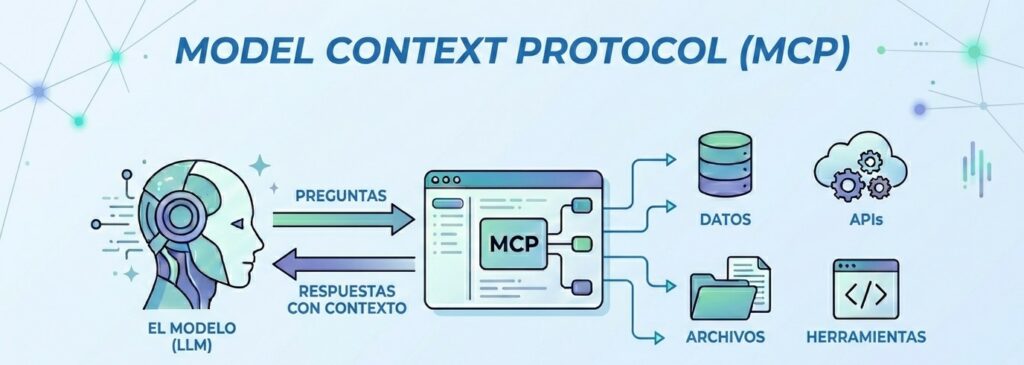
Why is the Model Context Protocol (MCP) the new standard for connecting AI and enterprise data?
One of the most relevant milestones of 2026 is the standardization of interoperability. The Model Context Protocol (MCP), an open architecture initially driven by Anthropic and rapidly adopted by the technological ecosystem, has solved the problem of “AI silos.”
-
Universal Data Connectivity: MCP allows an AI agent to connect securely to enterprise data sources (from a Snowflake Data Lake to an ERP like SAP) through a unified interface. According to data from the consultancy firm Gartner, companies that have implemented MCP-based architectures have reduced their AI integration costs by 40%.
-
Layered Security: Unlike traditional API integrations, MCP allows for defining which “tools” the model is permitted to use and under what privacy restrictions. This is vital at LISDATA, where we consider data integrity non-negotiable.
-
Model Agnosticism: MCP ensures that if a model superior to Claude or GPT emerges tomorrow, the company’s connector infrastructure does not have to be rebuilt. AI becomes “pluggable,” protecting investment in data assets.
Data Security and ROI: Is it better to invest in the Anthropic or OpenAI ecosystem?
As we approach the full application of the EU AI Act in August 2026, the choice of model is no longer just a matter of performance, but of legal compliance. Return on investment (ROI) in 2026 depends directly on efficiency in token consumption and the ability to avoid regulatory sanctions.
Constitutional AI vs. Azure Filters: Which offers greater compliance with the EU AI Act?
Security architecture is the point where both companies diverge most. For Compliance Officers, the difference is structural:
-
Claude (Anthropic) and Constitutional AI: Anthropic uses an “auto-correction” system based on predefined ethical principles (a constitution). This reduces harmful results to just 0.5%, compared to the sector average of 5%. Within the framework of the EU AI Act, this transparency “by design” facilitates the technical documentation required for high-risk AI systems, as the model has explicit behavioral rules that do not depend on external filters.
-
OpenAI and the Azure AI ecosystem: OpenAI delegates much of its corporate security to Azure AI Content Safety. This “output filter” based approach is extremely effective for companies already operating in the Microsoft stack, allowing for deep customization of risk categories. However, it requires active configuration by the IT team to meet the transparency and synthetic content labeling requirements demanded by European law in 2026.

Prompt Caching and API costs: Strategies to reduce AI operational spending at scale
In 2026, the cost of AI has become polarized. While frontier models have maintained their prices, efficiency is achieved through intelligent context management:
-
Prompt Caching: Anthropic has led this trend, allowing companies to “freeze” massive contexts (such as a factory operations manual or a 1M token codebase). This allows for reducing input costs by up to 90% on recurring queries. OpenAI has responded with its Batch API model, ideal for tasks that do not require real-time processing, offering 50% discounts on batch processing.
-
2026 Pricing Structure: Claude Opus 4.6 is priced at €4.31 per million input tokens, positioning itself as the “Premium” model for high-fidelity tasks. GPT-5.2/5.3 has optimized its price to €1.51 per million input tokens, seeking dominance in the high-volume market and integration into mass-consumer applications.
Decision Guide: How to choose the AI model according to your sector?
In 2026, market maturity has shown that there is no “one-size-fits-all” model for all needs. Strategic decision-making is now based on the balance between execution autonomy and reasoning fidelity.
Industry 4.0 Use Cases: Workflow Optimization with Autonomous Agents
The great revolution this year is the shift from predictive maintenance to agentic prescriptive maintenance.
-
Maintenance and Logistics: While in 2024 AI warned of a possible turbine failure, in 2026 integrated AI agents (such as those developed on GPT-5.3) can detect the anomaly, check inventory in the ERP, issue a purchase order for the necessary part, and reschedule the maintenance shift, all without manual human intervention.
-
Real-Time Quality Control: In sectors such as automotive or pharmaceuticals, agents based on Claude 4.6 are used for visual inspection and immediate regulatory compliance. Their low hallucination rate (less than 1% in controlled technical environments) ensures that quality deviations are identified and documented strictly following ISO protocols and the EU AI Act.
Multi-LLM Architecture: The value of integrating Claude and GPT into a single data pipeline
The organizations with the highest ROI in 2026 are those that have abandoned technological monism. An orchestrated Multi-LLM architecture allows for assigning each task to the most efficient “brain”:
-
Reasoning and Audit Layer (Claude 4.6): Responsible for analyzing contracts, 800-page technical manuals, and validating that the actions of other agents comply with company governance.
-
Interaction and Execution Layer (OpenAI GPT-5.3): Manages multimodal communication with operators (voice and vision) and the rapid execution of automation scripts.
-
Measurable Results: According to industrial adoption data from 2026, multi-model architectures reduce operational errors by 30% and optimize computational costs by directing simple tasks to more economical models (such as GPT-4o mini) and reserving frontier models only for critical reasoning.
AI Agents and the Data Spaces Kit: Sovereign Infrastructure for Automation
In 2026, the implementation of autonomous agents from Anthropic or OpenAI finds its maximum potential in industrial Data Spaces, where intelligence is deployed securely and sovereignly. Through the Data Spaces Kit program, companies can access grants of up to €30,000 to integrate their assets into shared ecosystems under the European standard. This infrastructure allows AI not only to analyze information but to execute critical processes (such as inventory management or prescriptive maintenance) without raw data ever leaving the organization’s control, ensuring strict compliance with the EU AI Act.
To materialize this autonomy, at LISDATA we orchestrate these models using Precedent, our platform that acts as a trusted demonstration center. Thanks to the use of EDC (Eclipse Dataspace Components) connectors, we facilitate an architecture where the algorithm moves toward the data and not the other way around, eliminating the risks of industrial secret leaks. As strategic partners, we handle the entire project lifecycle: from asset cleaning and technical configuration of the sovereign connector to the justification of the subsidy before March 31, 2026, transforming your data into a protected and profitable competitive advantage.
Why Choose LIS for Artificial Intelligence Consulting and Development
At LISDATA, we are experts in data and automation, which allows us to develop our own AI solutions with a solid foundation focused on results and business performance.
We focus on mid-sized and large companies
We adapt to each client’s reality and size, avoiding oversized projects and designing tailored artificial intelligence software.
As AI consultants and developers, we focus on delivering results
We are agile, approachable, and ensure direct involvement from experts from day one.
We are recognized across multiple industries
Industrial, logistics, technological, and legal sector companies already trust us to develop real applied artificial intelligence projects. Shall we talk?