
ChatGPT models in 2026: what each one does and which is right for you
Choosing between ChatGPT models requires clarifying what capability you need, where you will use it, and how much you are willing to pay. In addition, the models available in ChatGPT, ChatGPT Work, Codex, and the API do not always match.
The arrival of GPT-6.1 Sol changes the comparison with GPT-6 Astra and GPT-6 Luna. In this guide, we review their differences, API rates, and the criteria for choosing a model based on your task or business process.
Which ChatGPT models are worth comparing
OpenAI’s current catalog highlights three general-purpose models with different approaches:
- GPT-6 Astra. Designed for the most demanding reasoning and programming work.
- GPT-6.1 Sol. Aims to balance capability and cost for programming, computer use, and professional work.
- GPT-6 Luna. Designed for narrowly scoped, high-volume tasks where cost per run is especially important.
Earlier versions may still be relevant for certain setups. Therefore, when comparing results or pricing, you must identify the full version: GPT-5.6 Sol, GPT-6 Sol, and GPT-6.1 Sol are not interchangeable.
What changes with GPT-6.1 Sol
OpenAI positions GPT-6.1 Sol as a model with performance close to Astra for complex work, but at a lower cost. Its documentation highlights programming, computer use, and professional tasks.
The cost difference is significant. Its base API rates are $2 per million input tokens and $10 per million output tokens, compared with Astra’s $10 and $50. That is an 80% lower price per token, although the savings per task will depend on usage, the tools used, and retries.
For a company, this change justifies re-evaluating processes where Astra delivered good results but was too expensive. The decision should be based on tests with real documents and tasks, also measuring errors and review time.
Where you can use each model
It is important to distinguish between ChatGPT, ChatGPT Work, Codex, and the API. A model being available to integrate into an application does not mean it will appear under the same name in all ChatGPT selectors.
The GPT-6.1 Sol announcement includes its use in the API and Codex, subject to availability. In work environments, the subscribed plan, deployment, and administrator configuration may also play a role.
Before choosing, check which models you can use in your environment and what conditions apply. The per-token prices in this comparison correspond to the API, not the monthly price of a ChatGPT subscription.
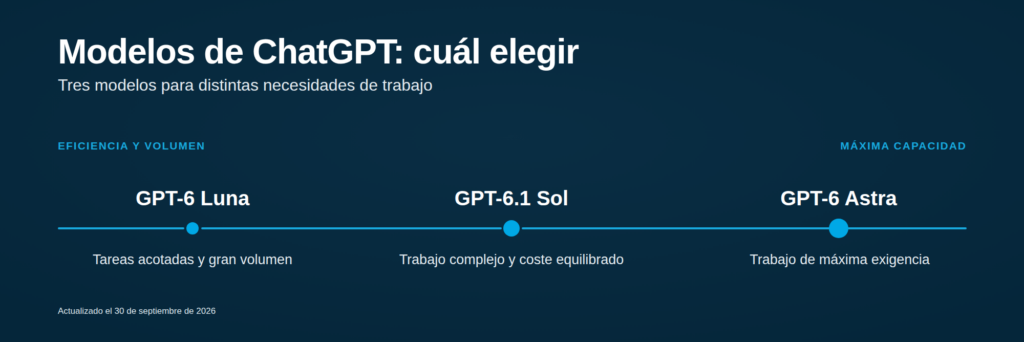
GPT-6 Luna, GPT-6.1 Sol, and GPT-6 Astra: guidance for choosing based on work needs.
How to interpret benchmarks when comparing models
Benchmarks help reveal differences in specific tasks, but their results depend on the model version, reasoning effort, tools, and execution conditions. A score from a previous generation does not automatically describe its successor.
To make a decision in a company, it is advisable to complement published tests with your own evaluation. Use examples that are representative of the process, include exceptions, and define in advance what result you will consider valid.
Compare response quality, execution time, cost per completed task, and the human intervention required. A model that is cheaper per token may stop being cheaper if it requires more attempts or more corrections.
The limitations of benchmarks
Benchmarks help compare models, but their results need context. Before turning them into a business decision, it is advisable to review several aspects.
Reasoning effort matters: A test run with a demanding configuration can improve the score, but it can also increase response time and consumption. Check whether those conditions resemble the ones you will use.
Tools and environment change the outcome: Evaluating a model on its own is not the same as allowing it to search for information, run code, or review its answers. Published performance corresponds to the full set of test conditions.
Test selection provides a partial view: Each evaluation measures certain capabilities. Review who publishes the results, what methodology they use, and which tasks are left out of the comparison.
Averages can hide the failure you care about: A high overall score does not guarantee good results with your documents, your data, or your process exceptions. In addition, results correspond to a specific version and should not be automatically attributed to another.
Consistency also matters: Beyond the accuracy rate, it is important to check whether the model maintains quality across runs and how much human review it needs. An aggregated score may not reflect that variability.
Availability affects the choice: Verify that the model and the evaluated features are available in your product, plan, and configuration. An advantage measured with tools you cannot access may not carry over to your environment.
How much each model costs in the API
These are the base input and output rates published by OpenAI, consulted on September 30, 2026. Amounts are expressed in dollars per million tokens.
| Model | Input | Output |
|---|---|---|
| GPT-6 Astra | 10 USD | 50 USD |
| GPT-6.1 Sol | 2 USD | 10 USD |
| GPT-6 Luna | 0.10 USD | 0.50 USD |
These figures allow for an initial comparison, but they do not equal the full cost of an automation. The budget must account for actual usage, tools, and applicable processing conditions.
Before calculating a monthly forecast, measure how much it costs to complete a task with acceptable quality and how many runs you will need.
Which model is best in each case
| Need | Starting point to evaluate | What to check |
|---|---|---|
| High-volume classification, extraction, or narrowly scoped summaries | GPT-6 Luna | Accuracy, exceptions, and cost per task |
| Programming and complex professional work | GPT-6.1 Sol | Quality, time, and need for corrections |
| Especially demanding tasks | Compare GPT-6.1 Sol with GPT-6 Astra | Whether the improvement justifies the cost difference |
| Analysis of extensive documentation | Compare with your own documents | Information retrieval, omissions, and fidelity |
| Processes involving actions in applications or systems | Evaluate the model within the full workflow | Permissions, traceability, and human validation points |
This table suggests where to start testing. The final choice depends on the process and the level of error you can accept.
How to choose without overcomplicating it
A simple rule helps structure the decision. Start with the cheapest model that can solve your task, and move up only when it fails in a measurable way. Doing the opposite—starting with the frontier model just because it has just launched—drives up the bill without guaranteeing a better result for your case.
To assess whether a model meets your requirements, prepare a representative sample of real tasks, include exceptions, and define the acceptance criteria before reviewing the results. This test will allow you to compare quality, cost, and the need for human review within your own process.
Who can help you decide
At LISDATA, we have been working since 2013 in data engineering, advanced analytics, and artificial intelligence for companies, with teams in Vitoria, Cantabria, and Hamburg. We are a Microsoft partner, work with Anthropic, and hold DAMA International certification in data governance. We understand that reliable agentic AI starts with data that is prepared, governed, and aligned with the business.
We set up these evaluations often, and the pattern repeats. Model choice is rarely the bottleneck; the bottlenecks are the state of the data, permissions, and the point at which a person validates before an action takes effect.
If you are deciding which model to work with or want to run the test with your own cases, please tell us about yours!
