
Business Intelligence vs. Big Data
In previous posts, we have discussed Business Intelligence and Big Data; however, many business users continue to use both terms as synonyms, when in reality they are not.
It is true that both concepts aim to offer answers on how to transform data into knowledge applicable for decision-making, and although they have comparable overlaps when used in the industry, they are different and offer organizations two unique ways to handle their data flows. We will attempt to differentiate between the two concepts.
What is Big Data?
There are many formal definitions of Big Data, but from all of them, we can conclude that the term refers to the vast amounts of varied information that can be collected and the way in which organizations can exploit them to generate knowledge.
As we mentioned in the post What is Big Data?, we can speak of Big Data systems when a series of characteristics converge, known as the 5Vs: Volume, Velocity, Variety, Veracity, and Value.
What is Business Intelligence?
As we already discussed in the entry What is Business Intelligence?, by BI we fundamentally refer to a set of techniques aimed at improving the decision-making process in a company. We are therefore talking about reports, dashboards, and other tools that provide a vision of the business and allow for the analysis of causes and effects.
How does Big Data differ from Business Intelligence?
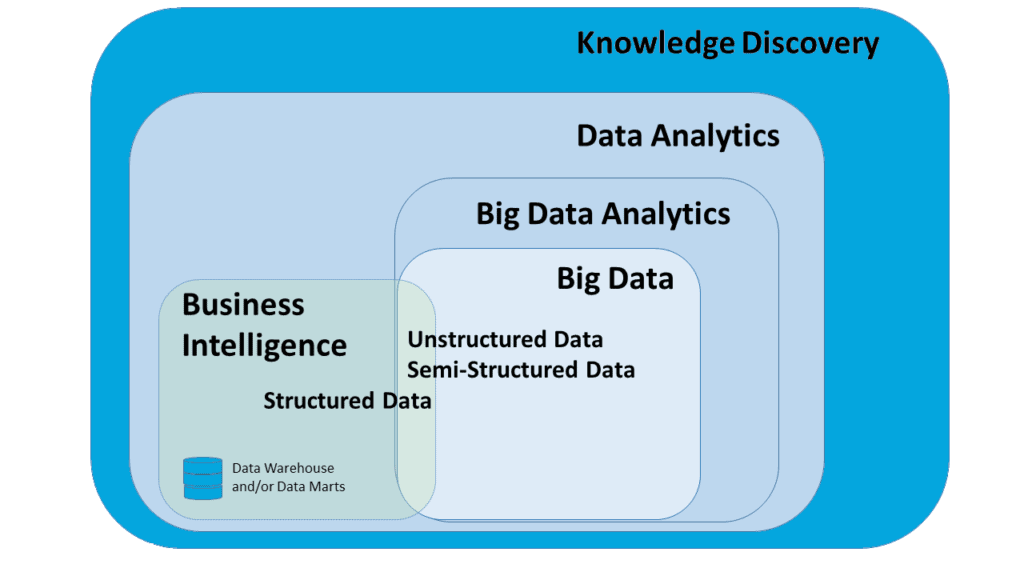
If we take a trip back in time and compare the traditional concept of Business Intelligence (the BI of the 90s, before the emergence of Big Data) with current Big Data, the differences between the two terms are significant:
- Business Intelligence solutions typically store information centrally, usually in a Data Warehouse, while Big Data environments often work with distributed file systems due to their large size.
- Furthermore, information processing in Big Data is performed where the data is stored, parallelizing said processing across several systems. In BI solutions, data is centralized and processed on a single server.
- While the data types handled by traditional BI systems are structured (tables, rows, columns, records…), Big Data almost always handles unstructured information.
- Traditional BI systems typically perform management of the organization’s historical information, while Big Data usually works with data obtained in real time.
However, today the boundary between the two terms is very thin. Current Business Intelligence solutions are not limited to analyzing historical and structured data from the organization, but also utilize operational and real-time data.
We can say that Big Data techniques serve to expand the capabilities of BI systems, allowing for the analysis of data that we could not handle until now and that may be relevant to the business and assist in decision-making. The traditional approach of BI systems is to provide historical answers to questions already known by the organization, while Big Data systems allow for new questions unknown to business users to be asked.
Does this mean that all BI solutions must include Big Data analysis? Absolutely not. In many cases, traditional BI solutions will be more than sufficient, while in others it will be necessary to “boost” them with the capabilities that Big Data provides.
Those cases will undoubtedly be those in which Big Data can provide accurate information that is of value for decision-making and whose cost of acquisition is viable for the organization.
At LISDATA, we propose solutions adapted to each specific company, analyzing the type of data it handles and the other variables necessary to prescribe the most appropriate BI + Big Data solution.
Share on Facebook
Share on Google
Share on Twitter
Share on LinkedIn
Share on Pinterest
Share on Print
Share on Email