

In this section
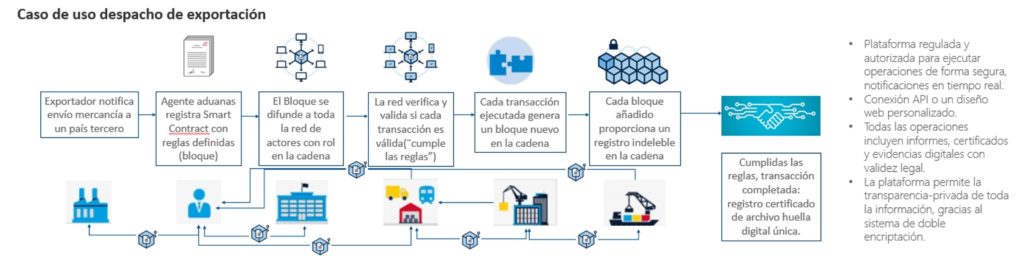
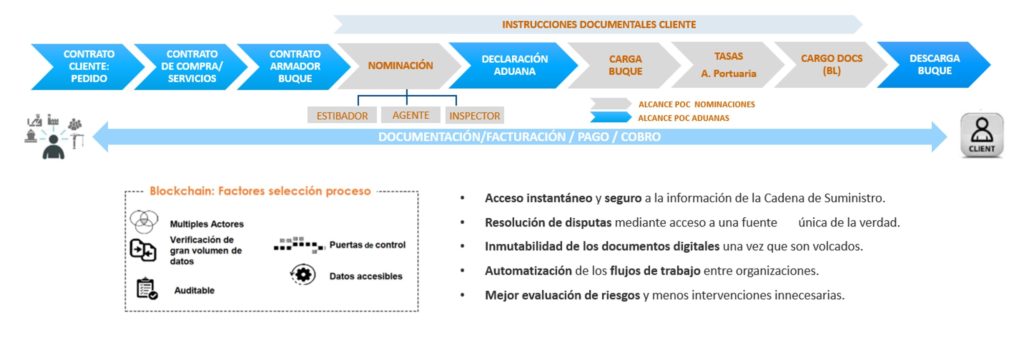
Through development based on Cloud, Blockchain, and Artificial Intelligence, we digitalize customs clearance and vessel nomination processes, achieving traceability and automation of operations in processes where validation and certification with a legal basis are required.
Objectives
- Automate digital operations with guarantees
- Reduce and optimize resources and costs
- Information privacy
- Personalization of the integrated platform for each participant/role within the Smart Contract/Blockchain chain
Documentary processes associated with vessel nominations, customs clearances, and others (health certificates, class inspections, Marpol certs, etc.) involve repetitive tasks and a multitude of agents involved in the review and approval or rejection chain of events, which is time-consuming and blocks resources, delaying the management capacity of a company or public entity.
What we do
We carry out the development of flexible software, built to provide guarantees and traceability in day-to-day digital business operations (communications, payments, agreements, signatures, contracts, etc.).
We can make use of smart contracts, a special type of instruction that is stored and managed using Blockchain technology, which has the capacity to self-execute actions according to a series of pre-programmed parameters.
How We Do It
Identification of Objectives, Actors, and Consensus Method
The first objective must be to set the scope, identifying actors and roles within the processes.
There are different consensus methods such as proof of work or stake, delegated proof of stake, proof of burn, and practical Byzantine fault-tolerant. Choosing the right one is fundamental.
Design and Architecture Selection
We select the most suitable platform from existing ones (Ethereum, Hyperledger, etc.), the internal structure of the node (permissioned, private, public, or hybrid), and the necessary hardware and software configurations.
APIs and User Interface
The correct configuration of communications and elements such as key management, address formats, block signatures, and permissions.
Regarding APIs, the generation of addresses and key pairs, functions, authentication, and data storage.
UI according to UX criteria.