
In this section
Using AI algorithms, a digital twin of the machine is generated, through which we can study the probability of success of a defined parameterization or setup. This allows us to generate suggestions for changes in machine variables where a higher success rate is predicted.
Objectives
- Propose variations in machine setup that lead to an improvement in the quality of the parts produced
- Evaluate the success rate of a specific machine parameterization or setup.
- Improve productivity by reducing defects resulting from an optimized setup.
- Increase the quality of the parts produced
Currently, the appropriate machine parameters for configuring the manufacturing of different part models are often not computerized. Consequently, tracking changes made during specific production runs is difficult, and improvements to these machine parameterizations (or setups) are slow and dependent on records being correctly traced and explained. Additionally, improvement proposals or changes are based on the specific knowledge of the operator in charge during the corresponding shift.
What we do
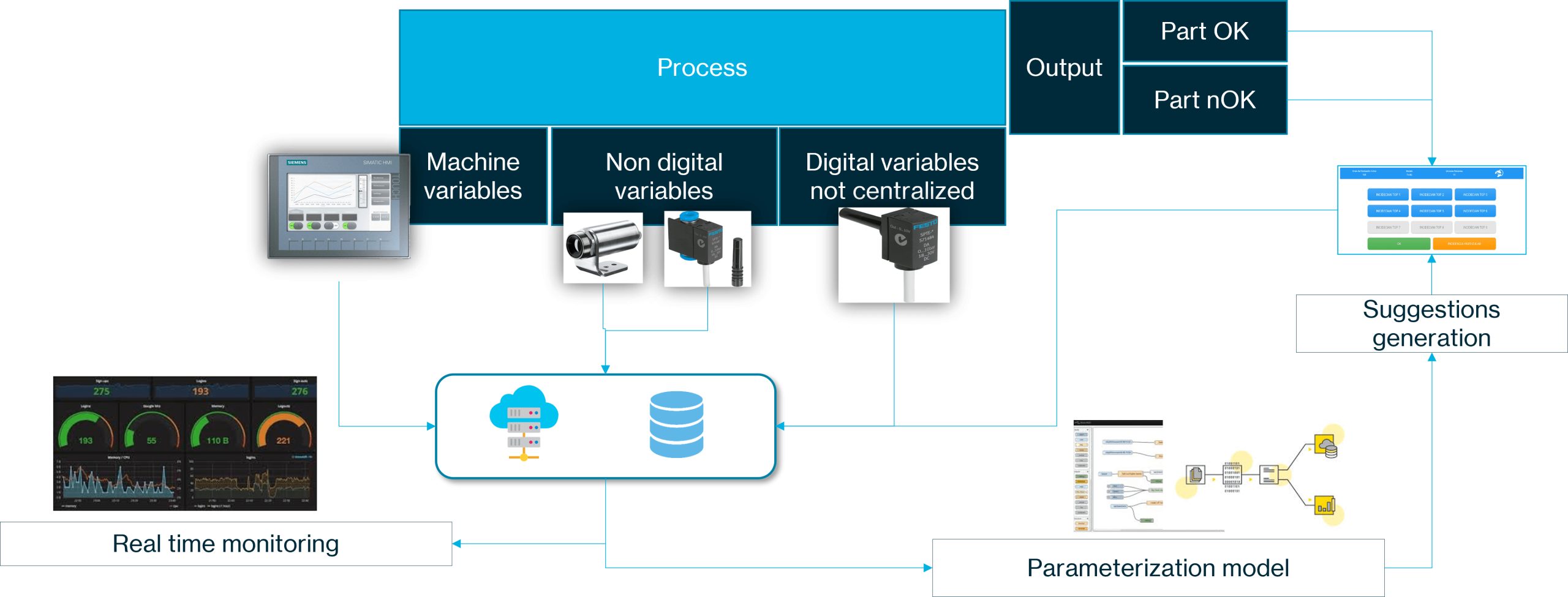
We provide our clients with a data storage and organization system that enables the correct and appropriate management of parameter modifications in the production environment. This achieves the information transparency necessary to evaluate production evolution objectively and efficiently.
Additionally, we utilize AI algorithms to establish a relationship between machine parameters and product quality, allowing us to generate suggestions for parametric modifications to improve the quality of the manufactured product.
How we do it
Support in production line sensorization.
Our engineers study the production process in relation to the quality of the data initially stored. Based on this, we project the quality of the result and, if necessary, propose additional sensorization to complete the production data collection.
Infrastructure and architecture of the storage system.
We offer total flexibility to work in different ecosystems, from client standards to the deployment of ad-hoc systems, whether on-premise, cloud-based, or hybrid, suitable for the efficient processing of target data.
Development of AI algorithms to establish the success probability model.
Our data analysts apply and model various algorithms to create a digital twin of the machine that relates machine parameters to part quality, resulting in the success probability of different setups.
Development of the suggestion generation system.
Thanks to the information provided by the model, we can generate alternative machine configurations with a better probability of success. This provides us with data-driven improvement proposals in an objective and transparent manner.