
What Is Data Mining?
Data Mining, also known as data mining, is focused on discovering patterns within a dataset. To achieve this goal, machine learning and artificial intelligence techniques are applied. One of the main functionalities sought in these techniques is to process raw information so that it becomes accessible and ready to be used by other systems or interpreted by end users.
What techniques are used in Data Mining?
Among the techniques used, we find clustering techniques such as:
- K-means or K-NN
- Variable reduction using the PCA technique
- Classification by parameters using decision trees
- Anomaly detection using mathematical tools such as t-statistics
- etc.
Through clustering, we are able to group data by common characteristics, meaning we can generate as many groups as we want. Elements within the same group will show common characteristics or patterns.
Thanks to variable reduction, we can turn computationally complex problems into computationally solvable ones. The idea behind this technique is to keep only the variables that truly provide information to the dataset, based on linear algebra principles.
Decision trees are logical construction diagrams, based on rules, used to represent and categorize a series of conditions that occur successively. This allows the dataset being studied to be classified.
Although we have mentioned these techniques, there are many others applied in this type of advanced data analytics.
Data Mining Process
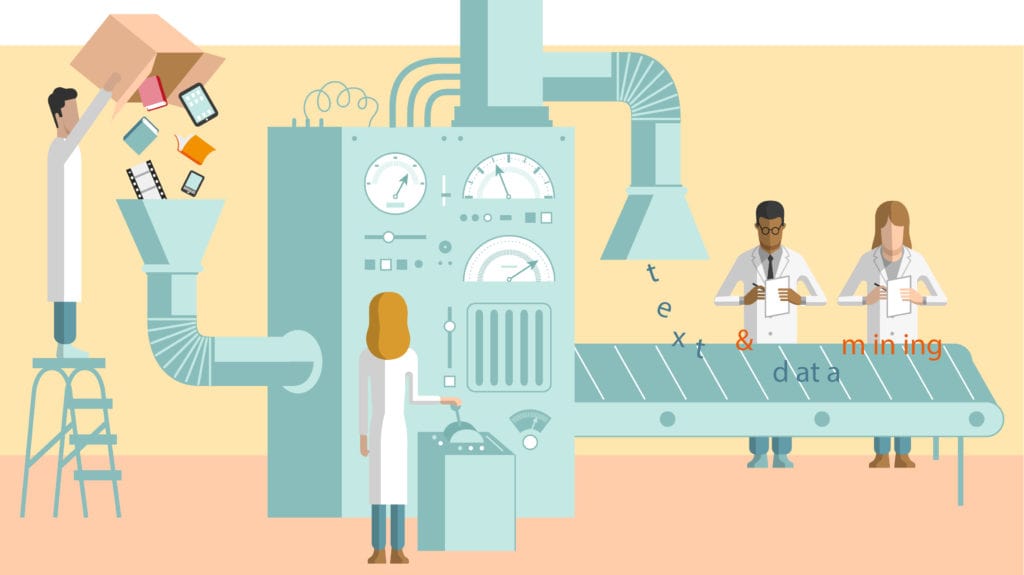
To successfully complete a data mining project, it is advisable to follow a structured approach.
Let’s look at an example procedure:
- Select the dataset: this dataset should be selected according to the objective set and the variables available to us.
- Analyze the dataset: before starting, it’s important to know what data we’re dealing with and how it’s distributed. For this reason, histograms and outliers are a good starting point for understanding our data.
- Data processing: we will prepare the data so that it suits the needs of the algorithm to be used.
- Apply the data mining algorithm: after studying the problem, we will proceed to apply the technique that best suits our problem and our data.
- Obtaining knowledge: after applying the selected algorithm, we will obtain the result. The result may come from one or several algorithms, depending on the complexity of the problem and the level of complexity we want to give the solution. Using more or fewer algorithms will not improve the final result. For an optimal result, we must choose the set of algorithms that best suits both the problem and the data.
- Evaluating the final result: after obtaining the models in the previous step, we will need to interpret the results obtained. It is important to verify the validity of the final results. All previous steps depend on this one to make sense.
What Is Data Mining Used For?
Before starting the data study, we need to clearly define the objectives we want to achieve. That’s why it’s important to know what we can accomplish through data mining.
For example, in a telephone company, we could use a decision tree to classify customers who have left the company.
If we’re dealing with an energy supply company, we could perform, based on consumption, a customer clustering to segment them. This way, we can generate a customer prototype and identify their consumption segment.
Thanks to these two examples, we could target our marketing campaigns to a very specific audience, identifying which group provides us with the most profitability and therefore focusing all our efforts on that particular audience. By understanding our target audience, we’ll have a good idea of their preferences and lifestyle, making it easier to reach them through an effective marketing strategy.
Share on Facebook
Share on Google
Share on Twitter
Share on LinkedIn
Share on Pinterest
Share on print
Share on email