
What is Blockchain?
Undoubtedly the word everyone is talking about. Its popularity is soaring, and for good reason. According to a recent PWC study, four out of five surveyed executives from large companies report having ongoing Blockchain initiatives.
This study reflects some data that shows the magnitude of this technology:
- 14% of healthcare companies are expected to implement Blockchain technology in their organization this year.
- By 2020, 46% of financial services will use Blockchain for their transactions.
- Over the next three to five years, the energy and public utilities sector will increase by 14%, and industrial manufacturing by 12%.
- At the Davos Forum, Blockchain was the second most used word (the first was Trump).
Why so much interest in Blockchain?
A well-designed blockchain not only eliminates intermediaries, reduces costs, and increases speed, scope, transparency, and traceability for many business processes. It also enables added value for customers, which many businesses are already monetizing.
When the database belongs to everyone.
This enormous ledger, which records every transaction, leaving an immutable record, belongs to each and every one of its members.
Let’s look at this concept with an example. Five friends exchange money with each other. Daily, money is sent from one to another without following a specific order. They decide to create a Blockchain among the five. The result allows each of them to know at all times which transactions have been carried out within the group, even without having been participants in them.
Imagine this concept multiplied by hundreds of thousands, and you will have a slight idea of the potential of this technology.
In this example, we see a use case for monetary transactions, but we can decide to share information buckets. And also, that this information can be programmable; this concept is known as Smart Contract.
Returning to information transactions, and to clarify the Blockchain concept, we will need to delve into more technical language that expresses the initial idea.
Let’s start by deconstructing the word Blockchain. Separated by Block and Chain. It is easy to imagine a chain linking one block to another and then to the next.
Why chain and blocks?
Well, each block contains all the transactions that have occurred during a period of time. On the other hand, the chain is formed by the last part of the previous block and the beginning of the next, known as the hash. This hash is created using SHA-256, which is a cryptography function that transforms readable and understandable information into an indecipherable forty-character alphanumeric code.
This chain is stored in each of the nodes of the Blockchain network, which, as we have just seen, can number in the hundreds of thousands. This is one of the reasons it is so secure.
If we return to the previous example, in the five friends’ Blockchain, it could be relatively simple for a hacker with sufficient knowledge to alter all five nodes at once and change the information contained in that network. However, when the information is distributed across thousands of nodes, the situation changes. To date, there has not been a single cyberattack that has been able to alter the Blockchain network.
How is the information replicated in each node simultaneously?
Nodes are like elite athletes who rapidly seek to close a block through trial and error until they find the combination that closes it and then start with the next one.
Once a node successfully closes the block, the information is immediately distributed to all nodes, which then contain the same blockchain information.
This property allows its application in a distributed environment, so that the Blockchain data structure can act as a non-relational public database containing an irrefutable historical record of information.
The Importance of Blockchain in Industry 4.0
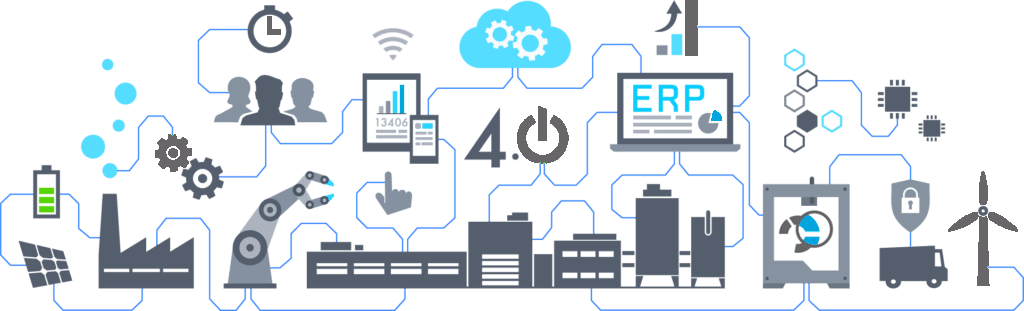
We are in a period of history with the fastest and most powerful technological advancements to date. The importance of adapting makes more sense than ever.
We have moved from isolated machines to being connected, first with IT networks, then to smart industrial tools. Smart Factories must be able to produce very short runs of small batches at the same time and price.
Furthermore, Industry 4.0 is already enabling a range of possibilities for new business models based on data, where data sovereignty is becoming increasingly important.
Resistance to sharing information is one of the main barriers to developing collaborative projects. Blockchain proposes a paradigm shift by offering a new system that allows users to move from a trust-based model to one based on transparency and security.
Blockchain technology allows every member of the network to have information available because it operates within it. Transparency is total, as any modification to the blockchain is recorded and distributed to all nodes.
Industry 4.0 is moving towards hyperconnectivity, where IoT networks, 5G, and all advanced data analytics technologies combine to make processes, organizations, and new business models increasingly efficient.
The industrial sectors in which this technology is developing are experiencing a highly positive evolution, reducing time and costs. Some examples of its applicability:
Automotive
- Vehicle-to-vehicle communication to facilitate the exchange of crypto assets, reduce traffic, handle bureaucratic procedures autonomously, etc.
- Monitoring, recording, and evaluating changes throughout the Supply Chain in the automotive industry.
Steel Industry
- Traceability and composition of materials ensuring product quality.
Aeronautics
- Traceability, lifecycle, maintenance, behavior study, and operations of components, as well as the study of design changes in product operation.
Energy
- User and energy provider will reach an agreement that allows energy flexibility through active demand management. In case of consumption peaks, they will activate protocols for users to reduce their consumption in exchange for compensation, favoring energy balance.
- Blockchain aims to regulate these types of activities, offering transparency and trust between providers and users.
Manufacturing Industry
- Disintermediation. Automation of processes that register users, allowing Smart factories to bid and close an agreement and immediately begin production without intermediaries.
Blockchain technology in Industry 4.0 serves as a platform offering multiple opportunities. Blockchain transactions enable a higher level of automation, achieving an optimal level of understanding between parties, thereby reducing costs, accelerating processes, and resulting in greater system flexibility.
Share on Facebook
Share on Google
Share on Twitter
Share on LinkedIn
Share on Pinterest
Share on Print
Share on Email