
What is a Data Mart and what are its benefits?
Large corporations store their data in warehouses, which meet organizational needs and support decision-making. Understanding the different technologies available and developing a sound data architecture is key to ensuring optimal use of that data.
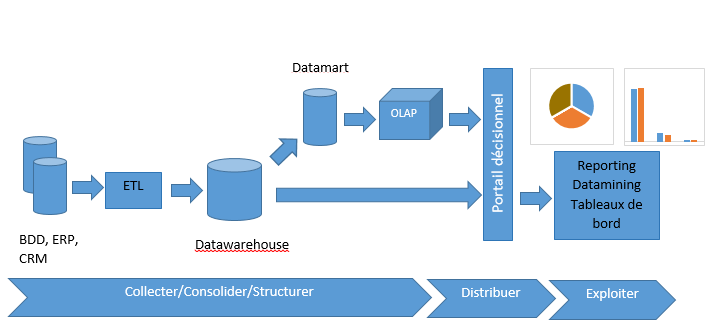
In this article, we will focus on Data Marts, data stores that leverage subsets of data, enabling analysis of the information generated within a specific department. In other words, it is a specific area of a Data Warehouse, designed to meet specific demands from particular areas of a company rather than the organization as a whole (Production, Sales, HR…).
Difference between a Data Warehouse and a Data Mart
A Data Warehouse is a large digital infrastructure that stores all of a company’s data. These presented a problem related to their growth: the more data, the greater the complexity and the lower the performance of queries on OLTP-type databases (Online Transaction Processing). Faced with this reality—massive Data Warehouses that are difficult to analyze—Data Marts emerged as a solution.
These data centers are also Business Intelligence tools primarily geared toward querying, but in this case at the departmental level. In other words, Data Marts are fragments of a Data Warehouse, from which they draw, intended for data analysis within a specific area of the organization.
In this way, information extraction is tailored to the needs of specific business units, enabling detailed analysis of the performance of specific departments. As a result, Data Marts provide key indicators for a given area, facilitating and optimizing decision-making.
Advantages of Data Marts
Data Marts are far more practical for departmental analysis. Let us look at a very illustrative example from analog management: a company may have hundreds or thousands of filing cabinets containing information for the entire company. If we need to find a specific piece of data, the search will be much easier, faster, and more efficient if those cabinets are divided by department, since we will search only those containing information for the area of interest, immediately excluding all the others. The same applies in digital environments.
Following this logic, a company can create a Data Mart for the Sales department that contains and manages the data relevant to professionals in that area. Based on that information, they can work with analyses, alerts, and KPIs specifically developed for their particular activity, improving decision-making and, consequently, operations. And this can be done for all other areas as well, with a financial Data Mart, a production Data Mart, a logistics Data Mart…
Benefits of Data Marts
Data Marts can be fed from the corporate Data Warehouse or draw from different data sources; however, regardless of how they are supplied, their use offers major advantages.
- Simplicity of creation compared to the more complex Data Warehouse structures.
- Ease of use.
- Lower technical requirements for implementation and maintenance.
- Faster querying.
- Detailed analysis of specific departments.
- Ability to identify threats and opportunities that may go unnoticed in high-level views.
- Improved decision-making.
Types of Data Mart
There are three main types of Data Mart depending on the type of data they use and their relational structure:
- Dependent data mart. This involves centralized data that depend on one another to ensure consistency.
- Independent data mart. These are usually small, do not use the central warehouse, and typically draw on external sources.
- Hybrid data mart. This is a combination of the above.
There is no longer any doubt that data is the new oil of the 21st century, and the information extracted from it is one of the main assets companies have—if not the main one. Data Lakes, Data Warehouses, and Data Marts are examples of the many tools businesses use to store and structure their information, enabling them to compete in a global, changing, and increasingly competitive world.