
Towards Airports 4.0
As in other sectors, the airport industry is set to undergo a profound and necessary transformation driven by Artificial Intelligence and Data Science. Operator forecasts suggest that the number of passengers passing through airports will double in the next 20 years, which will put the management structure of these spaces to the test.
Doubling airport traffic will require infrastructure expansion but, fundamentally, efficient management systems that allow, on the one hand, for a reduction in stay and waiting times and, on the other, for the streamlining of all procedures and actions—sometimes long and tedious—to which travelers are subjected during their airport visits.
The objective is to ensure a constant flow of passengers, avoiding the bottlenecks caused by check-in, security checkpoints, or information desks. Given this reality and the significant growth forecasts, the model must shift towards agile transit through operations that guarantee a high turnover of the millions of travelers who pass and will pass through airports every day.
Artificial Intelligence = Greater Airport Efficiency
This essential increase in sector efficiency will come from implementing the potential offered by Artificial Intelligence and Big Data, as the core technologies for Machine Learning, Deep Learning, Business Intelligence, RPA, and many others. To achieve the increased speed in airport operations we are discussing, the process automation provided by all this technology is indispensable.
In fact, the international airport sector is already in the process of implementing Artificial Intelligence solutions in customer service, security, and logistics tasks as the first steps on the road to Airport 4.0 management.
Customer service and user experience are becoming more efficient thanks to the development of bots that can handle the needs of thousands of passengers at once, in hundreds of languages. These systems have the capacity to explain to travelers where they need to go and offer permanently updated, real-time information on boarding, arrivals, ongoing flights, etc., enabling ground staff to focus on higher value-added tasks.
Undoubtedly, the most necessary yet tedious and time-consuming obligation is passing through security controls. In the near future, this process will be carried out almost automatically, if not completely automatically, as passengers move through specific corridors or conveyor belts, thanks to advances in sensors, Internet of Things (IoT) systems, and Computer Vision. Biometric recognition, digital identifiers (tokens), and abandoned object detection systems will make airports safer while spending less time on control tasks that currently require arriving at facilities well in advance and contribute to high concentrations of passengers in terminals.
Digital Twins
Sensors and the Internet of Things also enable work on data obtained in real time and the creation of Digital Twins with which to design devices or test new management models without assuming any risk. These tools, as their name suggests, generate a virtual replica of real environments—in this case, the airport—to simulate possible situations that may occur or changes required in operating methods.
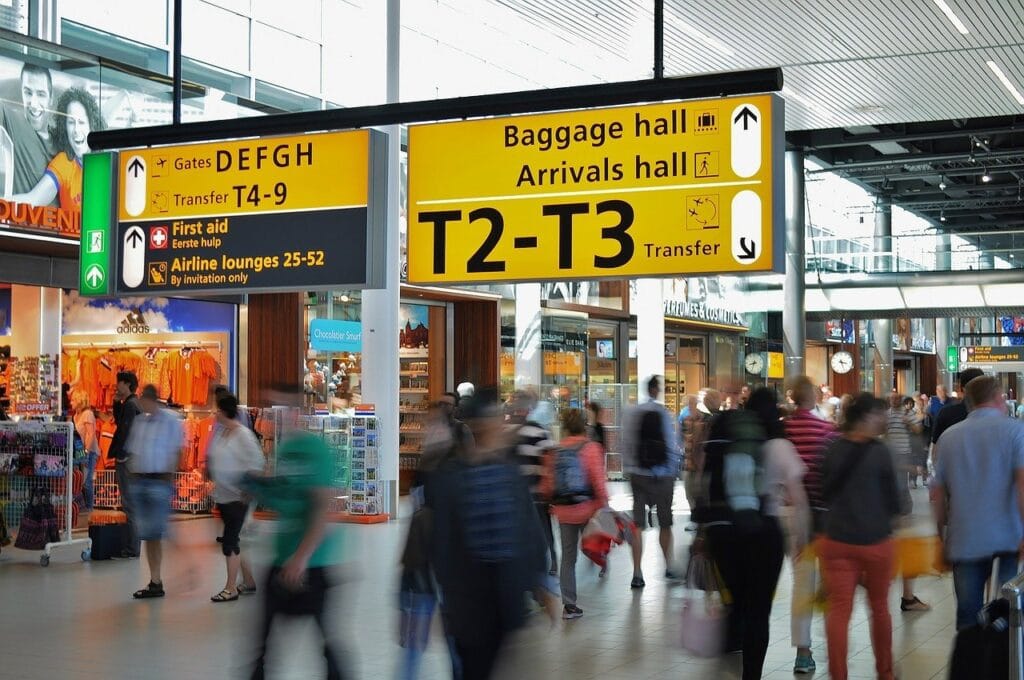
Suppose a destination becomes popular and flights increase, constantly concentrating travelers in its area. A mirror system, as they are also known, makes it possible to test the terminal’s operation on the Digital Twin by swapping that boarding gate with another located in a clearer area, surrounded by less busy destinations, for example. Or in the reverse case, for arrivals, placing it near the baggage claim belts to ensure rapid exit traffic for passengers.
Another graphic example is the design of operations following the agreement of new flights or increased frequencies with airlines. Thanks to the combination of Artificial Intelligence, specifically Machine Learning, and a digital twin, the new situation can be simulated to analyze and make decisions regarding infrastructure transit, human resource needs, gate selection for each flight, logistics operations, cleaning, and more. In other words, the future is visualized to understand the requirements of the changes to be adopted and to make the best decisions based on certainty.
Demand Forecasting
Demand Forecasting systems also help in working with certainties, proving highly useful when making forecasts regarding passenger influx, consumption at airport facilities, or the cargo transport that will be required in the future. Anticipating needs, once again, simplifies decision-making and makes it more accurate, leading to much more effective management of available facilities, personnel, and resources.
The basis of these systems is once again data exploitation, working with internal and external sources: ERP, CRM, work calendars, economic indicators, weather, activity history, market trends, promotional campaigns, etc. These will be processed with predictive algorithms to transform them into high-quality information regarding the future demand for the services provided. In this way, it is possible to anticipate occupancy peaks and their consequent operational needs to have them covered by the time they materialize.
Conclusion
As we can see, Advanced Data Analytics, Artificial Intelligence, Computer Vision, and other emerging technologies will play a significant role in addressing the exponential growth expected in airport traffic. Infrastructure does not have infinite growth, so the key to system sustainability will lie in increasing passenger turnover and decreasing airport stay ratios—tasks to which Data Science is already beginning to contribute.