
Shop Floor Data Collection: Unmasking the ‘Hidden Factory’
It is no secret that a priority for any organization seeking to maximize profitability is cost reduction. These costs can be evident and therefore easily addressed; presumed, requiring analysis for confirmation; or hidden—the most interesting, yet also those that will always go unnoticed unless specific measures are taken to move them into the first category.
If costs remain hidden, it is because they are not visible to the naked eye, which does not mean they do not exist. So, if we cannot see them… how can we bring to light unnecessary expenses derived from processes with unknown or imperceptible inefficiencies? The answer lies in the digitalization of production processes. The task of searching for and evidencing hidden costs has found its greatest and best allies in Advanced Data Analytics and Industry 4.0, through which we can improve and optimize production processes by objectively and meticulously measuring their performance.
Automating data collection in any type of plant, through IIoT (Industrial Internet of Things) devices and MES (Manufacturing Execution Systems), allows for an understanding of the actual performance of the business, rather than just the perceived one. This unmasks what is known as the ‘hidden factory’ or ‘ghost factory’—that other reality that affects processes but is not taken into account because it is not even known. Applying Artificial Intelligence to the manufacturing chain brings the submerged part of the iceberg to the surface, allowing for more complete analyses by relating all information—not just what is available, but what actually exists.
Whether it is data generated by the PLC governing the machinery, incidents reported by shop floor or warehouse personnel, or information present in MRP, MES, or CMMS systems, Industry 4.0 allows this data to be compiled and processed together, to measure and interrelate all business parameters, providing a global vision. Furthermore, these analyses lay the groundwork for subsequent performance studies or OEE calculations, continuous process improvement (e-Kaizen), predictive maintenance, and production parameterization and forecasting.
Production Process Control
This ability to extract and analyze all data generated on the shop floor enables exhaustive, real-time control of the entire manufacturing process, from its initial step to the finished product. In this way, it is possible to identify failures, performance drops, bottlenecks, or any production process anomaly the moment they occur, allowing for immediate correction.
Furthermore, unlike manual data collection, automated data capture guarantees reliable, error-free, continuous, and instantaneous information. This allows for constant monitoring of actual activity compared to planned activity (expectations) to analyze deviations and, once again, implement corrective actions to achieve desirable continuous improvement.
However, for data to provide these benefits, it must be processed and presented legibly. In the first step of this phase, the protagonists are mathematical algorithms defined to extract and obtain the necessary information for each specific case. Subsequently, the implementation of another disruptive technology, Business Intelligence, translates the resulting series into evident and non-evident layers—already treated in previous mathematical operations—and transports them to visual, simple, and intuitive dashboards. These are adapted to each user role, facilitating decision-making at all levels of execution, from shop floor operators to senior management.
Benefits of Shop Floor Data Collection
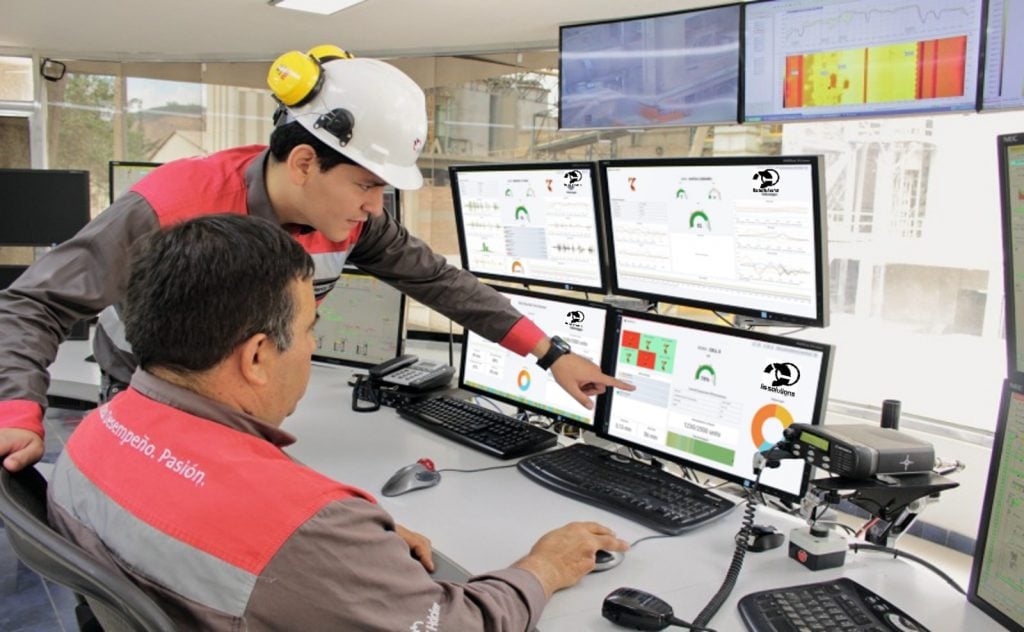
Obtaining complete information on industrial processes, viewable in real time on multi-user dashboards, generates multiple business benefits:
OBJECTIVE INFORMATION
The mathematical relationship of measured data provides an objective view of the correlations affecting processes. Methodology is standardized, and corporate knowledge is generated.
TIME SAVINGS
Automating data collection and gathering tasks frees up time that can be used in the production process or in analyzing the information obtained.
INCREASED PRODUCTIVITY
Having all the information on what is happening on the shop floor second by second facilitates decision-making and empowers operators to react, gaining productivity, competitiveness, and profitability.
INSTANT INFORMATION
We can check machine efficiency, production costs, the existence and behavior of bottlenecks, downtime, or low performance, and all records considered critical to the process at the exact moment incidents occur.
COMPREHENSIVENESS AND TRANSVERSALITY OF INFORMATION
Data is collected constantly and the information is complete. The automation of the ETL (Extract-Transform-Load) workflow allows us to detect changes and generate a history, optimizing our processing and storage needs. No critical data escapes the analytics.
This comprehensiveness enables information to be analyzed by different departments—quality, production, maintenance, management—to make the best decisions aligned with each client’s specific strategy.
Conclusion
Automating shop floor data collection allows for second-by-second knowledge of actual process performance, bringing hidden information to light. Leveraging all available data series—evident, presumed, and hidden—provides a complete and 100% objective view of the manufacturing chain, evidencing process progress and facilitating sound decision-making at all times and across all departmental levels.
The digitalization of business environments makes it possible to perform an X-ray of the production environment to analyze and maintain full control over mechanical failures, financial leaks, performance drops, quality losses, etc. As in medicine, knowledge, experience, and patient examination offer a general view of a potential problem, which is then supplemented by diagnostic tests to reveal pathologies hidden from the naked eye or that escape the physician’s intuition—in other words, to understand the reality of the situation from which the appropriate treatment will be established.
Thanks to the advances offered by new technologies and the path toward Industry 4.0, we can evidence the true performance of companies in real time. The ‘hidden factory’ is uncovered, putting an end to inefficient processes, optimizing performance, reducing costs, and therefore increasing profits and quality.