
OEE: Overall Equipment Effectiveness

Understanding industrial machinery productivity peaks, efficiency drops, bottlenecks, stoppages, high rejection rates, or any type of incident is crucial to ensure maximum production chain performance. But how can we know if processes are being carried out optimally at all times? The answer is simple: by thoroughly analyzing their performance through the capture and processing of the data they generate.
In the era of Industry 4.0, the digitalization of plants allows for real-time access to all information from the manufacturing chain. The great advance and differentiation from traditional systems lie in two subtle but fundamental nuances: “real-time” and “all information,” both equally important. Being able to know the performance of a machine, a line, or the company as a whole in “real-time” allows for instantaneous action to address incidents that harm processes. On the other hand, in new Smart Factories, “all information” is extracted, not just parts of it, even if it remains in hidden layers, so decision-making is based on objective and complete data.
To extract the data we refer to, multiple measurement systems exist, although most are based on OEE calculation (Overall Equipment Effectiveness) to understand the real status of work lines and facilitate decision-making, in order to achieve higher levels of productivity and, therefore, profitability.
What is OEE?
The OEE calculation, as a fundamental part of a MES (Manufacturing Execution System), allows us to understand in detail the efficiency of each part of the production process, based on the data it provides, to maximize the performance of industrial environments.
Through this system, a numerical value is obtained that shows the real efficiency of industrial machinery, and it can be applied to a single production unit, to specific lines, or to the entire plant. Regardless of the extent of its implementation, this indicator offers a detailed radiography of the production chain, exposing less efficient processes so that improvement efforts can be focused on them, gaining in performance and quality and, consequently, in profitability.
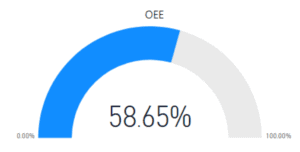
The OEE calculation is based on the combination of three parameters: availability (relates available time to productive time), performance (utilization of machinery capabilities), and quality (evaluates rejection or rework rates). The product of these indicators results, as mentioned, in a single percentage value that represents the efficiency of the manufacturing process. A 100% OEE embodies the perfect manufacturing process where the machine has operated for all planned time, at the maximum possible speed, resulting in defect-free products.
OEE = Availability × Performance × Quality
How is information collected?
Within the framework of Industry 4.0, the information generated by industrial equipment is compiled through IIoT (Industrial Internet of Things) devices, which capture data in real-time and allow for its monitoring, storage, and interconnection with ERPs, MRPs, and MES systems, to avoid duplication in result processing.
Parallel sources, such as operational personnel, complement the automatic data ingestion from machines through the use of mobile capture applications. An example is those created with Power Apps. As we have already mentioned in previous posts, this Power Platform tool, based on Artificial Intelligence, displays information to the user but also collects it through simple forms and connects it with pre-existing databases. This enriches the collection process, increasing workstation productivity while capturing critical variables for proper analysis.
With the extracted data, Business Intelligence tools come into play, enabling us to transform the results obtained from performance analysis and calculation into dynamic visualizations and multi-user dashboards, with which to intuitively monitor, study, and control the processed information.
Benefits of the OEE system
- Real-time information acquisition
- Identification of inefficiencies (bottlenecks, slowdowns, idle peaks…)
- Improved industrial machinery performance
- Increased product quality
- Reduction or elimination of rejection rates
- Reduced preventive maintenance and repair costs
- Facilitates decision-making
- Improved competitiveness (cost reduction + quality increase)
Conclusion
The OEE Calculation offers a simple and visual metric in the form of a percentage, resulting from the product of availability, performance, and quality, which measures the effectiveness of industrial machinery. This value allows us to optimize production processes by locating faults, performance drops, quality degradation, bottlenecks, etc., facilitating the complex task of decision-making.
In Industry 4.0, the automation of data collection for performance analysis through IoT devices complements the use of this system, as it presents all available information in real-time on dashboards for analyzing the manufacturing process. This analysis increases plant performance by revealing inefficiencies, allowing work and money to be focused on correcting critical points, thereby increasing productivity, product quality, and improving customer service.