
LIS Women: Promoting equality in STEM
Every year on February 11, International Day of Women and Girls in Science is celebrated, a date that aims to highlight the work and achievements of women in technical fields and scientific production, and to promote gender equality. At LISDATA, several colleagues have spoken to us about their work and shared their perspective on a reality in which there is still work to be done.
The long road to equity in STEM
In recent years, the landscape for women in STEM disciplines (Science, Technology, Engineering and Mathematics) has seen significant improvements. Awareness campaigns and other actions have been carried out by both the public and private sectors to help women thrive in a sector traditionally dominated by men. In Spain, these advances have been reflected in a notable increase in the number of women choosing STEM degrees. For example, according to data from the National Statistics Institute (INE), the percentage of women enrolled in STEM-related university programmes grew by 8% between 2010 and 2020.
The increase in the number of women pursuing higher education in scientific or technical fields demonstrates growing interest in, and recognition of, the importance of women’s participation in key areas for innovation and technological development. However, despite this progress, women still account for just under 30% of enrolments in STEM degrees and 16% of the workforce in ICT-sector companies, and they are also very often absent from decision-making positions (only 15% of women hold management roles in Spain). The path towards equity continues.
The LIS Team: A firm commitment to equality
At LISDATA, we believe in the importance of promoting equality at all levels, which has led us, from the outset, to encourage the incorporation of women into our team and their professional development within it. We have an Equality Plan and a Protocol against Workplace, Sexual and Gender-Based Harassment, and we promote work–life balance with measures such as flexible working hours and the option to work remotely. As a result, women currently represent 35% of our workforce. This is still a modest figure, but in the context of STEM in Spain, it shows that we are moving in the right direction.
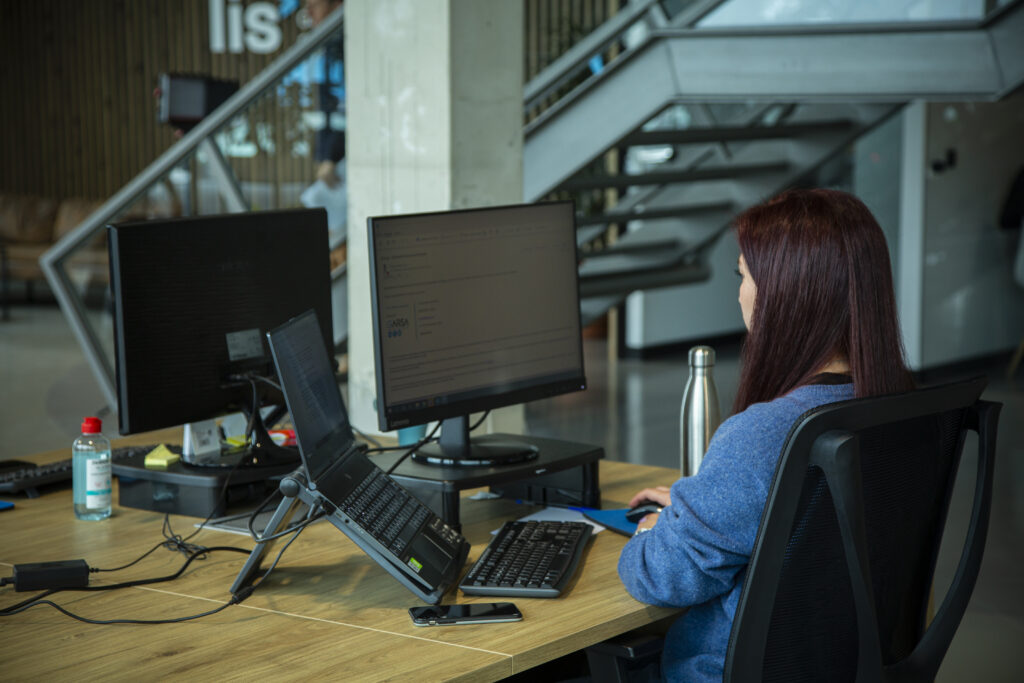
We celebrate the International Day of Women and Girls in Science
On the occasion of the International Day of Women and Girls in Science, some colleagues from the LIS Team wanted to tell us how they got started in the world of science and technology and how they view their current work. It has not been easy to choose 6 testimonials, and there would be enough material for just as many articles, but we believe these voices reflect well the feelings of the 33 women in the LIS Team.
For Alicia Grande, a project manager in the R&D team, who had a technical and IT vocation from an early age and studied Telecommunications Engineering on the advice of a private tutor, her work is “a never-ending learning process and a way to do my bit in the evolution of AI”. She notes that she still remembers some mocking comments from secondary school teachers when she said she wanted to be an engineer, although she acknowledges that things are changing. “I do hope, though, that it stops being unusual to find women in senior roles or in project management.”
Transport area developer Andrea Noriega, who has always had a deep interest in nature and “a natural talent for mathematics”, studied Physics and a master’s degree in Data Science. Today, she enjoys “the sense of camaraderie you feel at LIS, with colleagues always willing to lend a hand”. She also values having a job that is “anything but monotonous” and in which, she says, she has never perceived discrimination.
Developer Ana González has not felt treated differently for being a woman either. A biotechnologist, she entered the world of data science through the Data Science master’s programme at the University of Cantabria. What she highlights about her work at LISDATA is that she enjoys learning from different disciplines and working with people whose background differs from her own. “I love programming and the creativity it drives, the possibilities it gives you,” she confesses. She is also pleased that the role of women in STEM disciplines is becoming increasingly recognised. “We have always been there. Now we need to remember it more than ever so that girls do not doubt that this can be their path,” she says.
Project manager Teresa Ortego studied Business Administration and Tourism, but has ended up developing her career in a technology company and working closely with highly technical profiles. “I enjoy learning more about this area and discussing topics with the development teams,” she tells us. From her time at LISDATA, she values that “on a human level, they are always looking out for you”, as well as the number of female colleagues in technical roles. “A few years ago, things were not like this in this sector.”
Fellow project manager Ana Cordero, a telecommunications engineer by training, says she heard during her years of study “unfortunate comments from acquaintances, belittling or attacking women simply for being women”. On the other hand, she appreciates having had female teachers and former students as role models, as well as “being able to keep growing and learning in completely new areas and technologies” now that she is developing her career in the STEM world.
Finally, María García, a mathematician and “a fan of sudokus, chess and puzzles” since childhood, mentions “the number of interesting challenges and growth opportunities” she enjoys at LISDATA. She is currently a developer in the Data Warehouse and Business Intelligence area, and although she says she has not experienced discrimination in her working life, she points out how “women have to constantly prove our capabilities and commitment”. María is very clear, however, that “we have come to STEM to stay”.