
HR Management with Business Intelligence Tools
As we have already mentioned in previous posts, Business Intelligence systems have been used in companies for some time. Traditionally, the departments that have been most involved in their use are the financial and commercial departments. This seems logical, as these are the departments where information analysis is most evident for improving company decision-making. However, they are by no means the only ones that influence a company’s success.
Human Resources departments are vital to company objectives, as they are responsible for obtaining maximum performance from the members of the organization.
Currently, these departments generate more data than ever. Not only is employee payroll information handled, but data is also stored on compensation and benefits management, information on staff experience and training, as well as information on personnel planning and control, shift management, attendance and performance time control, occupational accident rates, etc.
The main problem lies in the fact that this data is extremely difficult to transform into useful information for daily management and strategic decision-making, making it practically impossible to do so manually and efficiently. This is where Business Intelligence tools make even more sense, providing Human Resources managers with a series of keys to continuously optimize their department.
The keys to using Business Intelligence in Human Resources
The data normally available to the HR department can usually be divided into three types:
- Data on payroll, remuneration, and personnel administration
- Data on personnel planning and control: shifts, time control, attendance, etc.
- Data on talent management, from recruitment to development within the organization.
BI systems organize all this data, transform it into information, and visualize it through measurable indicators to assist in decision-making.
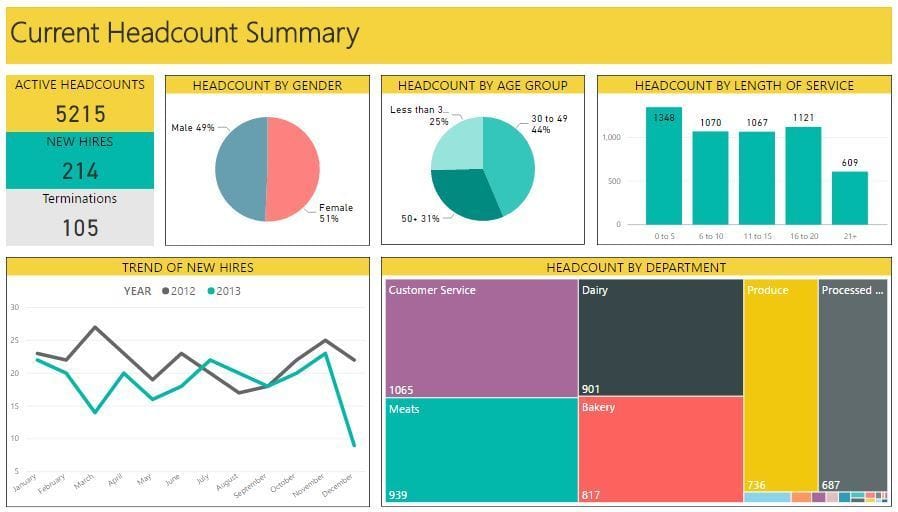
The most relevant aspects that can be monitored are:
- Cost control: these allow for the determination of personnel costs, their evolution over time, and the analysis of distribution by profiles, geographical areas, gender, age, or any other demographic consideration of interest, as well as the comparison of salaries against market rates, internal pay equity criteria, etc.
- Workforce management: the company’s labor structure over time and staff turnover from any organizational, demographic, or geographical point of view.
- Productivity: measuring how each worker contributes to the sales and income generated by the company, and its evolution over time. Comparison with other employees or specific control groups.
- Absenteeism control: evolution and economic impact of absenteeism, attendance control, and calculation of accident rates.
- Talent management: company success is based on having the right people to achieve company objectives, with the necessary experience and knowledge and with costs appropriate for each position. Knowing the talent we have and what we truly need for each defined position is critical for determining the recruitment, training, and remuneration plans for our workforce.
- Motivation and work environment: another aspect that is increasingly gaining relevance in the field of human resources is generating motivation and a good work environment. Here, the processing of information regarding staff departures and data from surveys on employee suggestions and commitment become relevant.
In short, having a Business Intelligence system that visualizes the evolution of key indicators and their possible deviations has become an indispensable tool for any HR manager.
Share on Facebook
Share on Google
Share on Twitter
Share on LinkedIn
Share on Pinterest
Share on Print
Share on Email