
GPT-6 Astra: What Changes in ChatGPT and What It Implies for Businesses
OpenAI has introduced GPT-6 Astra, its new artificial intelligence model and one of the most significant advances in the recent evolution of ChatGPT. The model began rolling out on September 3, 2026, and arrives with improvements specifically aimed at complex work, including programming, research, navigation, computer use, and the execution of multi-step tasks.
For a ChatGPT user, these improvements can translate into an assistant capable of taking on more demanding and comprehensive jobs. In the business sphere, however, the interpretation goes further. The question is no longer just what an artificial intelligence model can answer, but what tasks it can execute, what information it can work with, under what permissions, and how it integrates within a corporate process. The advancement lies in a greater capacity to intervene in jobs that until now required a constant succession of instructions and supervision.
What is GPT-6 Astra?
GPT-6 Astra is the new advanced model from OpenAI. The company particularly highlights its capabilities in areas such as computer and browser use, programming, cybersecurity, scientific research, and professional work.
One of its main features is its ability to handle complex tasks from start to finish. Until relatively recently, the most common interaction with ChatGPT followed this logic: a person entered a request, the model generated a response, and the user used that content to continue working outside the system itself.
The evolution of these models is progressively modifying this dynamic. GPT-6 Astra can perform better in jobs composed of different phases, maintain context during longer processes, and combine different actions within the same task. It can also participate in the creation of documents, spreadsheets, or presentations by following instructions and adapting to new requirements during the process.
From a business perspective, this change is especially relevant because it brings artificial intelligence closer to a scenario where it is no longer limited to generating content. It increasingly has the capacity to actively participate within specific workflows.
Every new artificial intelligence model usually generates the same question in organizations: should we use it? The answer depends much less on the model’s power than it might initially seem.
More advanced technology can execute more complex tasks, but the business impact remains conditioned by issues such as data quality and availability, integration with existing systems, access permissions, security, or the correct definition of the use case.
For this reason, incorporating GPT-6 Astra simply because it offers better capabilities does not in itself guarantee an improvement in productivity, costs, or efficiency. The truly relevant question is which organizational processes can benefit from those capabilities and how that benefit can be measured afterward.
Possible areas of application are broad. A company can explore access to and exploitation of internal knowledge, generation and review of documentation, analysis of large amounts of information, support for technical teams, automation of administrative tasks, or specific processes related to programming, research, and software maintenance.
Not all of these cases necessarily need the most advanced model available. In many projects, the choice of model is just one more decision within a much larger set of technical and business factors.
This is where working with a specialized technological partner can be especially relevant. Proper guidance allows for analyzing which use cases have the greatest potential, evaluating if the organization has the necessary data, establishing security requirements, and developing the integrations that allow artificial intelligence to be incorporated into existing systems and processes.
The model is, ultimately, one of the pieces of the project. Its capacity turns into value when technology, data, and real business needs are correctly aligned.
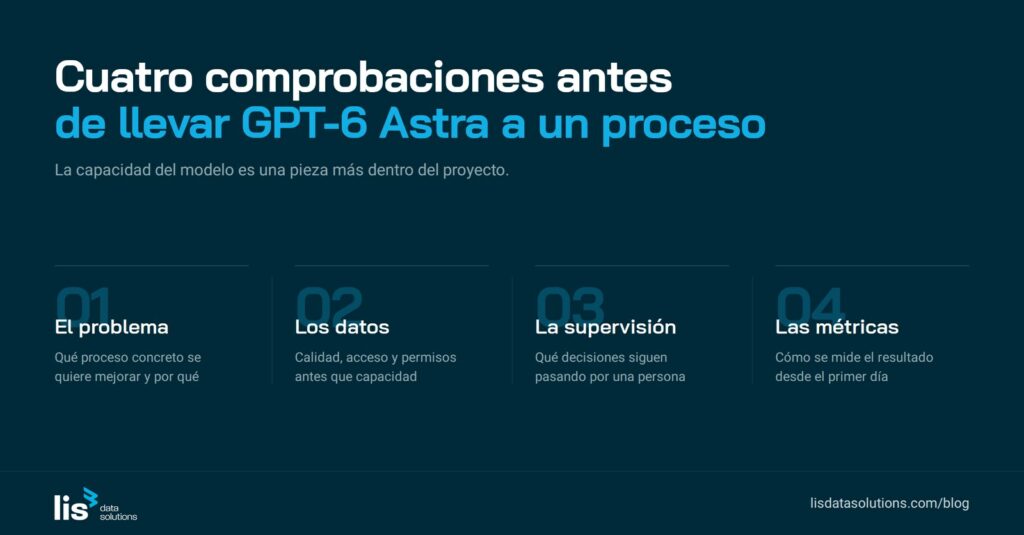
The four checks that should be completed before bringing GPT-6 Astra into a process
The Real Leap is in the Processes
The evolution of ChatGPT also reflects a broader shift within enterprise artificial intelligence. During the early years of generative AI expansion, much of the focus was concentrated on chatbots and the possibility of interacting with a model through natural language.
That scenario is evolving toward systems capable of consulting information, using tools, and executing actions as part of a process. This difference considerably expands the type of developments an organization can consider.
One system can access corporate documentation to help a worker locate information. Another can collect data from different sources, analyze it, and prepare a report. In other cases, artificial intelligence can assist in certain phases of an operational, technical, or administrative process.
The relevant change is that AI stops being isolated in a conversation window and starts connecting with the daily operations of the company. As this interaction capacity increases, so does the importance of correctly defining what information the system can consult, what tools it can use, what actions it is allowed to execute, and when a person must intervene.
GPT-6 Astra Reaches Critical Level in Cybersecurity
One of the aspects that deserves the most attention from a business perspective is the classification of GPT-6 Astra within OpenAI’s Preparedness Framework. Astra is the company’s first model to reach the Critical level in capabilities related to cybersecurity.
This classification needs context. It does not mean that GPT-6 Astra has been defined as an insecure product; rather, it refers to the level of capability the model itself can reach in certain cybersecurity tasks. According to information published by OpenAI, the model can perform advanced tasks within this field when it has the appropriate tools and access. This evolution has also led the company to reinforce various security, monitoring, and control measures.
For businesses, the most useful conclusion relates to governance. The more capabilities a model has and the greater its connection to corporate information, applications, or tools, the more important it becomes to establish access limits and supervision mechanisms.
Why is GPT-6 Astra initially disabled in Enterprise?
This need for control is also reflected in the way OpenAI is managing its deployment in certain business environments. During launch, access to Astra is disabled by default in eligible Enterprise workspaces and must be enabled by their administrators.
This type of configuration allows organizations to decide in a more controlled manner when to incorporate the model and which profiles should have access to it. The issue takes on special importance when artificial intelligence can consult corporate information or use tools to complete a task.
In this scenario, business management of artificial intelligence goes beyond deciding who can use ChatGPT. It also involves determining which models each profile can use, what information they can work on, and what level of capability should be available based on each user’s responsibilities.
What a Company Should Evaluate Before Implementing GPT-6 Astra
The arrival of a more powerful model should not automatically accelerate its implementation. Before introducing it into business processes, several issues need to be analyzed:
- Identify the problem to be solved: Starting directly with the technology can lead to projects that are difficult to justify and even harder to measure. It is more useful to start by locating processes with repetitive tasks, high completion times, difficulties in accessing information, or specific opportunities for improvement.
- Evaluate the state of the data: The model’s capability does not compensate for a deficient information base. Outdated documentation, fragmented sources, quality issues, or difficulties in accessing data can considerably limit any artificial intelligence development. Permissions and access constitute another fundamental aspect. Not all users need to consult the same information, nor should all systems have the same level of autonomy. This issue becomes even more relevant when a model can interact directly with company applications or tools.
- Define which tasks need human supervision: Automating a process does not necessarily mean eliminating human intervention. There are decisions that, due to their economic, operational, legal, or reputational impact, continue to require validation.
- Have metrics from the start to evaluate results: The number of interactions with a model provides little information about its business impact. Indicators such as time saved, reduction in manual tasks, decrease in errors, productivity, or response speed allow for a much more precise evaluation of whether the development is generating value.
When will GPT-6 Astra be available?
OpenAI began the rollout of GPT-6 Astra on September 3, 2026, for a limited set of organizations and has planned a progressive expansion of its availability.
During this first phase, access may vary depending on the product, the plan contracted, and the workspace configuration. In the case of Enterprise environments, administrators’ decisions regarding which models are available to different users also play a role. Therefore, the absence of Astra within a specific account does not necessarily imply a configuration problem. The model is still in a progressive rollout phase.
GPT-6 Astra Does Not Change a Fundamental Rule of Enterprise AI
Artificial intelligence models will continue to increase their capabilities. However, having more powerful technology does not reduce the importance of understanding the business. Rather, the opposite is true.
A company does not obtain value simply by accessing the latest available model. It obtains it when it correctly identifies where to apply AI, has the necessary data, establishes appropriate controls, and develops an integration adapted to its processes and the people who work with them. The business adoption of technologies like GPT-6 Astra therefore requires strategy, business knowledge, data engineering, development, and technological integration.
At LISDATA, we work alongside organizations throughout that entire journey, from needs analysis and use case identification to the development, implementation, and evolution of data engineering, advanced analytics, and artificial intelligence projects.
Having a technological partner allows for assessing which capabilities make sense in each context and converting them into developments adapted to the reality of each organization. GPT-6 Astra expands what is technically possible, but the business challenge remains the same: transforming that technological capacity into real improvements for the business.

Frequently Asked Questions about GPT-6 Astra
We answer some frequently asked questions (FAQs) about OpenAI’s new model.
What is GPT-6 Astra?
GPT-6 Astra is a new advanced model from OpenAI introduced in September 2026. It incorporates improvements in areas such as programming, research, navigation, computer use, cybersecurity, and multi-phase professional work.
Is GPT-6 Astra available in ChatGPT?
Its rollout is being carried out progressively. Availability may vary depending on the plan, the product used, and, in business environments, the configuration established by administrators.
Is GPT-6 Astra suitable for businesses?
It can be particularly interesting for processes that combine analysis, information generation, tool use, or automation. Its suitability will always depend on the use case, available data, security requirements, and necessary integrations.
What does it mean for GPT-6 Astra to have a Critical level in cybersecurity?
The classification refers to the level of capability the model can reach in certain cybersecurity tasks. It does not mean the product has been considered unsafe, but rather that its capabilities require greater control and supervision measures.