
Examples of Data Mining Use Cases
As we have written in previous posts, Data Mining, or “data mining”, is a set of techniques used to explore large volumes of data (Big Data), discovering patterns within them and thus transforming them into valuable information. Advanced analytics techniques such as PCA, Decision Trees, or Neural Networks, and even other techniques or technologies such as Machine Learning, have unlimited power and can be applied in any situation we may encounter, provided we feed them with the appropriate data.
Nowadays, we can find use cases in a wide range of areas, from the business sector to medicine, cybersecurity, science, or politics. More than one president has become one thanks to the intelligent use of data mining techniques and algorithms.
Leaving politics aside, today we would like to present some examples of how data mining can help businesses.
Using Data Mining in business
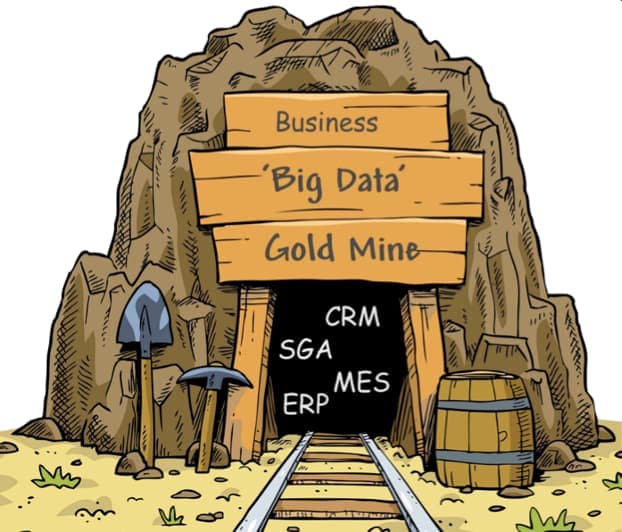
ERP, CRM, MES, WMS… these are some of the most common systems we find in today’s companies. Each one, in its specialized area, helps us organize and manage companies and administrative processes. To do so, they contain all the relevant and necessary information for successful management. At the same time, with all the data they handle, these systems can represent a gold mine for data scientists and, together with external databases—often freely accessible—it is possible to build highly valuable Data Mining models that help us improve decision-making.
Data mining can be very useful in the sales and marketing area. Above all, in the B2C sector, the relationship with the customer can be very complex. At the same time, this relationship determines an organization’s success or failure. With data on customers, their activities, and actions, different data mining models can be created. For example, we can create automatic segmentation by distinguishing customers based on their potential. With this information, we can focus marketing efforts on customers with the highest potential. Different customer profiles can also be created, and personalized campaigns can be launched based on their needs or specific interests. Another example we have carried out at LISDATA is the identification of churn patterns and their prediction (Churn Forecast). In many industries—especially those based on subscription strategies—it can be very valuable to detect as early as possible customers who are considering ending their subscription or contract. By analyzing past churn data, it is possible to identify patterns that help us determine which customers to focus on in order to prevent churn.
Although often overlooked, Data Mining can also be applied in the human resources department, helping us better understand and manage our employees. One example we carried out at LISDATA was the ergonomic optimization of workstations by analyzing in depth and correlating data on the workstation, tasks, and employees.
Data mining is also applied in the production area, and with the emergence of Industry 4.0 it is becoming increasingly important. Data can help us optimize production and logistics processes. The most striking example is predictive maintenance.
Machines are a true data mine that helps us understand how they are performing and whether they have any issues. By analyzing past failures and problems, patterns can be identified using specific Data Mining algorithms. These patterns can be interpreted as symptoms a machine shows before it breaks down. In this case, data mining becomes a doctor for machines, helping us identify problems with enough lead time to address them in a more optimal way.
These are some examples of how Data Mining can be used in business, and there are many more across all business areas. The only requirement is the availability of meaningful data.
Conclusion
As we can see, Data Mining can significantly help in different areas of business management. Although implementing projects of this type requires an initial investment, in general, companies that use data mining quickly achieve a return on investment. With the successful completion of the first Data Mining projects, a much deeper change is often initiated within companies by developing a data-driven culture.
At LISDATA, we support and deliver Data Mining projects to extract the full value contained in data, creating high-value knowledge that helps optimize decision-making and business strategy.
Share on facebook
Share on google
Share on twitter
Share on linkedin
Share on pinterest
Share on print
Share on email