
Computer Vision Counting Systems
The rapid and constant development of computer vision, driven by the continuous and rapid evolution of artificial intelligence and advanced analytics, is enabling its application to an increasing number of tasks across more sectors. Surveillance, anomaly detection, defect identification, and material classification are tasks already entrusted to computer vision, which solves them with high levels of efficiency, far superior to what human capabilities can contribute to these processes.
A further step has been taken by providing computers not only with the ability to see, but also the ability to learn from the images they receive and analyze (machine learning). In this way, by training systems to recognize specific visual elements, they can perform operations autonomously, saving teams time and ensuring maximum process efficiency.
One of the tasks where computer vision is being successfully employed, and which we will focus on in this post, is counting products, materials, packages, etc. By capturing images, whether video or photographic, determining the quantity of elements, products, or people within a specific frame is a much faster, more precise, and accurate task. In tenths of a second, a count can be obtained for the contents of a pallet, stacked items, articles on warehouse shelves, fruits passing on a conveyor belt, vehicles on a road, or people in an enclosure, for example.
All this information, obtained in real-time with virtually 100% reliability in the results, greatly simplifies the execution of mechanical tasks, such as packaging items with various units (seeds, screws…), receiving or dispatching materials (metal sheets, wooden slats…), or stock management (parcels, finished products…), and facilitates decision-making, saving time and increasing efficiency.
COUNTING SYSTEMS
COMPUTER VISION
Unleash the full potential of technology and artificial intelligence in your business
Image capture and processing
The process to obtain the counting result is extremely simple: just take an image of the material, whether homogeneous or heterogeneous, that needs to be counted. Based on this image, the system will determine the quantity of references, their position, and the date and time of the count, providing information in real-time and generating an activity history that can later be used for stock management, demand prediction, logistics optimization, and more.
Therefore, for computer vision to perform this function, we need optical photo or video capture devices, which are now widespread and constantly within our reach thanks to smartphones and tablets—very useful tools, for example, throughout the supply chain. Once the image is captured, advanced algorithms intervene in the process, analyzing the information provided by the image based on predefined parameters according to the objective to be achieved, for which the system has been previously trained.
Based on our experience in developing computer vision systems for counting various elements, we can affirm that these tools yield very good results. They are highly reliable, with an effectiveness exceeding 98% in identifying primary SKUs (Stock Keeping Units) or unique reference numbers.
However, for the process to reach such levels of operability, a prior training stage of the algorithm with real images is necessary, as we have already pointed out. In this way, the system will learn to recognize the images we want it to identify, automating recognition processes and optimizing application performance. Let’s look at two examples to visualize what we are explaining.
Examples of counting by computer vision
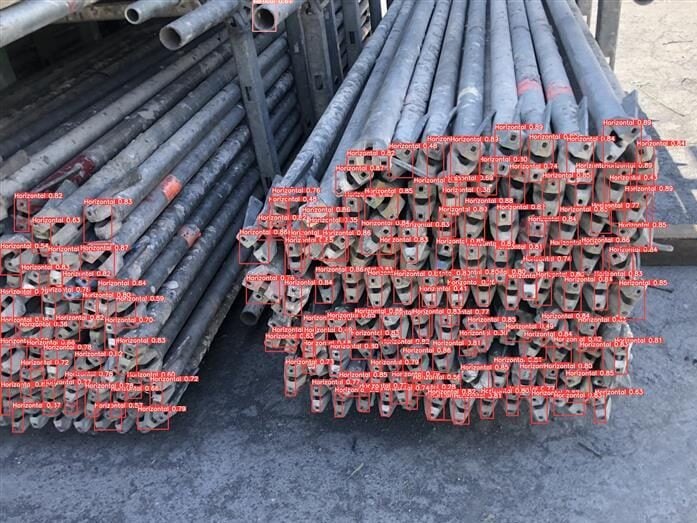
Let’s say a truck loaded with dozens of identical, small-diameter rebar rods, stacked like the scaffolding parts shown in Figure 2, arrives at an industrial facility. To inventory the transport and the units to be entered into the warehouse, operators only need to take a photo of the load with a smartphone or tablet, according to the specified frame. The system, trained for this specific circumstance and as many others as needed in the business environment, will analyze the image and recognize the elements contained within it as unique pieces. Consequently, it will provide us with a real-time count of the units to be received, saving us a lot of time in the process.
Another widespread use case would be counting parts or products as they pass along conveyor belts in high-production lines. For example, a food industry receives massive quantities of apples, which are distributed at high speed on belts during their production process. The combination of cameras and computer vision programs developed and trained for this purpose will identify the fruits based on the characteristics the system has been trained with, and will provide a count of the units processed.
These tasks, often due to volume and speed, exceed the capabilities of traditional sensors, making machine vision a great alternative. Furthermore, it can combine counting with anomaly detection in articles, a process we will discuss in a new blog post.